
In this story
Rust is a chemical change, not a stain
Rust is the common name for the reddish-brown products formed when iron corrodes. It is often described as iron oxide, but that description is a useful simplification rather than a complete chemical formula. Rust usually contains hydrated iron oxides and hydroxides, meaning that water is incorporated into, or associated with, the solid. Its exact composition can vary with humidity, acidity, salt concentration and the amount of oxygen available.
The same process can affect steel because most ordinary steel contains iron. When a steel nail, fence, car panel or bridge is exposed to a damp atmosphere, some of its iron atoms gradually leave the metallic structure and become dissolved iron ions. Those ions later combine with oxygen and water to form the solid substances we recognise as rust. This is why rusting changes the material itself rather than merely placing a coloured film on its surface.
Three ingredients make the reaction possible
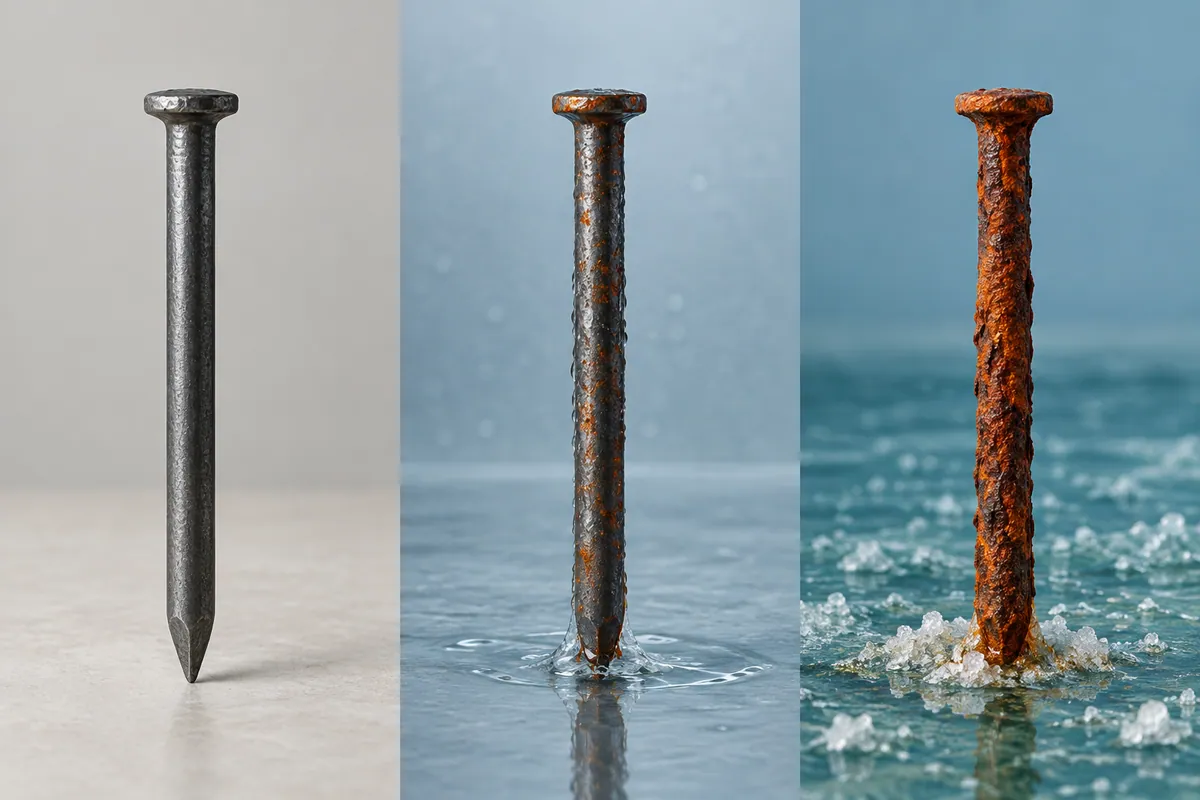
The basic requirements are iron, water and oxygen. Remove water, and the ions cannot move easily across the surface. Remove oxygen, and the main electron-accepting reaction is greatly reduced. This is why dry iron can remain unchanged for long periods, while iron exposed to humid air can slowly corrode even when there is no visible puddle. A very thin layer of moisture is enough to support the electrochemical process.
Pure water is not necessarily the fastest environment for rusting. Dissolved substances such as salts make the water a better electrolyte, allowing charged particles to move more readily. Salt does not have to be present for rust to form, but salty moisture commonly speeds corrosion. This helps explain why steel structures near the sea, or vehicles exposed to salted roads, can deteriorate faster than similar objects kept in a clean, dry environment.
The rate also depends on temperature, acidity, the condition of the surface and how readily oxygen reaches different parts of the metal. For that reason, two iron objects exposed to apparently similar weather may rust at noticeably different rates.
A tiny battery forms on the metal surface
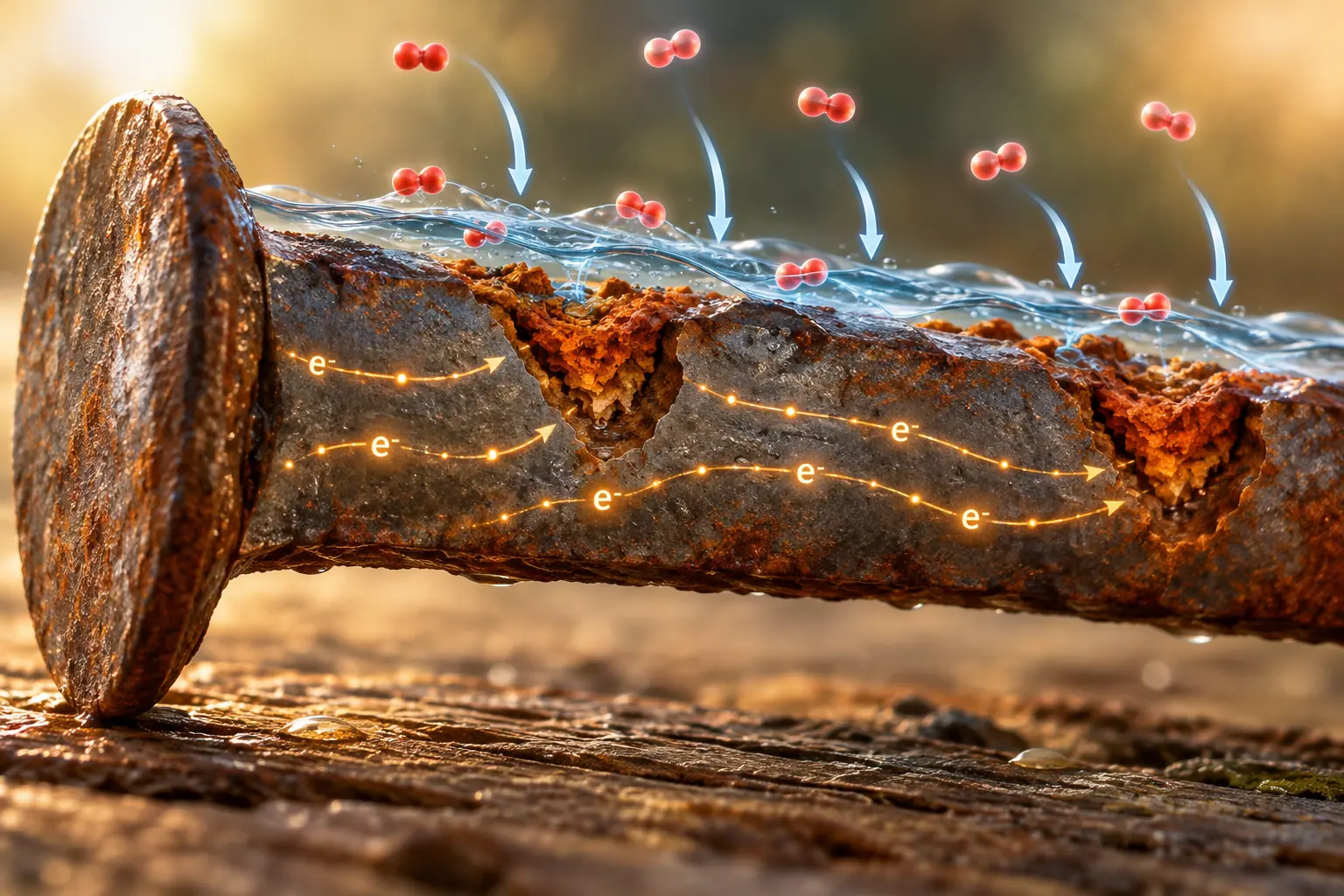
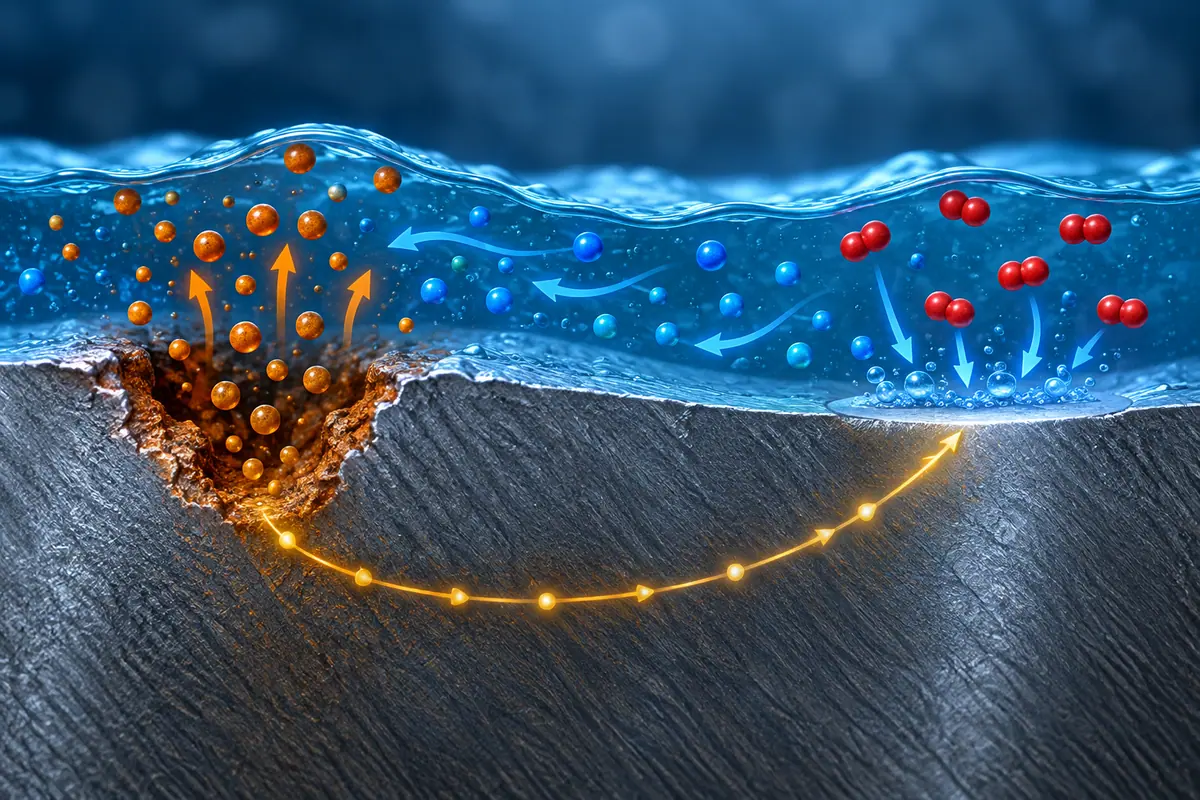
Rusting is an electrochemical process. In simple terms, different microscopic regions of the same iron surface act like the two sides of a battery. At an anodic region, iron atoms lose electrons and enter the moisture as iron ions. The electrons remain in the conducting metal and travel to another region, called the cathodic region.
At the cathodic region, oxygen reacts with water and the electrons to produce hydroxide ions. The water film therefore does two jobs: it provides a route for ions to move across the surface, and it helps complete the chemical reactions. The metal carries electrons internally, while the damp layer carries ions externally. Together, these two paths form a tiny corrosion cell.
The anodic and cathodic regions are not permanent components marked on the object. They can shift as the surface changes. Scratches, bends, impurities, deposits and differences in oxygen concentration can all make one location more likely to lose iron than another. Corrosion can therefore create small pits in one area while rust accumulates nearby.
How iron turns into the orange-brown material
The first important step is the oxidation of metallic iron. In simplified form, an iron atom gives up electrons and becomes an iron(II) ion. Oxygen is reduced elsewhere on the surface, producing hydroxide ions in the moisture. The iron(II) ions and hydroxide ions can form iron hydroxide, which is then further changed by oxygen and water.
As this sequence continues, iron(II) compounds are oxidised to iron(III) compounds. These products combine into poorly ordered, hydrated solids such as iron(III) oxyhydroxides and hydrated iron oxides. Their mixture, particle size and water content influence whether the rust looks yellow, orange, red-brown or nearly black.
There is no single reaction that describes every rusting situation perfectly. Chemistry references commonly use simplified equations to show the main electron transfers, while the actual surface contains several compounds and changing local conditions. The established principle is clear: iron is oxidised, oxygen is reduced, and water helps the electrochemical reactions proceed.
Why rust keeps spreading instead of protecting the metal
Some metals form a compact oxide layer that adheres tightly and blocks further attack. Aluminium is a familiar example: its thin oxide film is difficult to see but can protect the metal beneath. Rust on iron behaves differently. It is generally porous, poorly attached and prone to cracking or flaking.
When rust flakes away, it exposes new iron to air and moisture. Water can also collect in pits and beneath loose flakes, creating conditions for further corrosion. The visible orange coating is therefore not a reliable protective shield. In many cases it is evidence that the underlying metal is gradually being consumed.
Rust can even make an object appear larger while the original metal is being lost. The corrosion products occupy more volume than the iron from which they formed, so flakes and bulges may develop around pits. Eventually, enough metal can disappear for a thin sheet, pipe or structural component to weaken significantly.
Why salt, scratches and trapped water make rust worse
Salt accelerates rust mainly because it increases the electrical conductivity of the moisture film. The ions in salty water help complete the corrosion circuit. Road salt is particularly effective because it remains behind after water evaporates, ready to dissolve again when the surface becomes wet.
A scratch through paint exposes bare steel. If water becomes trapped at the damaged area, the exposed metal can become an anodic site while nearby painted regions receive oxygen differently. This uneven access to oxygen can concentrate corrosion at the small damaged spot rather than spreading it evenly across the whole surface.
Crevices and overlaps can be especially vulnerable because they hold moisture while limiting fresh oxygen from reaching some parts of the metal. Differences in oxygen concentration can create what is called differential-aeration corrosion. The exact pattern depends on the geometry and environment, but the general result is that hidden, damp spaces can corrode quickly.
What to remember
- Rust is a family of hydrated iron oxides and hydroxides, not one perfectly defined substance.
- Iron rusting requires iron, water and oxygen; dissolved salts usually speed the electrochemical process but are not essential.
- Microscopic anodic and cathodic regions form a corrosion cell on the metal surface.
- Rust flakes and lets water and oxygen reach fresh iron, so it usually fails to protect the metal underneath.
- Paint, oil and other barriers work by excluding water and oxygen. Zinc coatings add sacrificial protection because zinc corrodes preferentially to steel.
Sources & further reading
Where this story comes from
- Corrosion Protection of SteelNational Institutes of Health, Office of Research Facilities
- Corrosion: Undesirable Redox ReactionsChemistry LibreTexts
- CorrosionChemistry LibreTexts, University of Toronto course materials
- Corrosion Manual for Internal Corrosion of Water Distribution SystemsUnited States Environmental Protection Agency
- Corrosion Protection for SteelAmerican Galvanizers Association
- Rust Converter: When the Rust Settles, Convert ItNational Park Service, National Center for Preservation Technology and Training
This story was researched, drafted and illustrated with AI, then automatically checked against ANTB's structural and sourcing rules. Use the linked primary and institutional sources to verify important details.
 How things work · 5 min read
 How things work · 6 min read
 How things work · 6 min read