

In this story
A bridge is not completely rigid
A bridge may look solid and immovable, but its deck is constantly responding to its surroundings. Steel and concrete both change length when their temperature changes. The amount of movement depends on the material, the size of the bridge and the temperature difference it experiences.
This movement is usually tiny compared with the total length of the bridge, but a small change repeated across a long structure can become significant. A bridge deck several hundred metres long may need to accommodate movement at its ends or at points between separate sections. The Federal Highway Administration describes deck expansion joints as components that accommodate thermal movement in bridge superstructures.
Concrete also changes length for other reasons. It can shrink as it dries, and the structure can move or rotate slightly as vehicles cross it. Bridge design therefore has to consider more than whether the bridge can carry its weight. It must also allow controlled movement without creating damaging stresses.
What happens when the weather changes?
Imagine a bridge deck on a hot summer day. As the deck warms, it tries to become slightly longer. In cold weather, it contracts. If the deck were held rigidly at both ends, the attempted change in length would create internal forces. Those forces could contribute to cracking, distortion or damage around supports and connections.
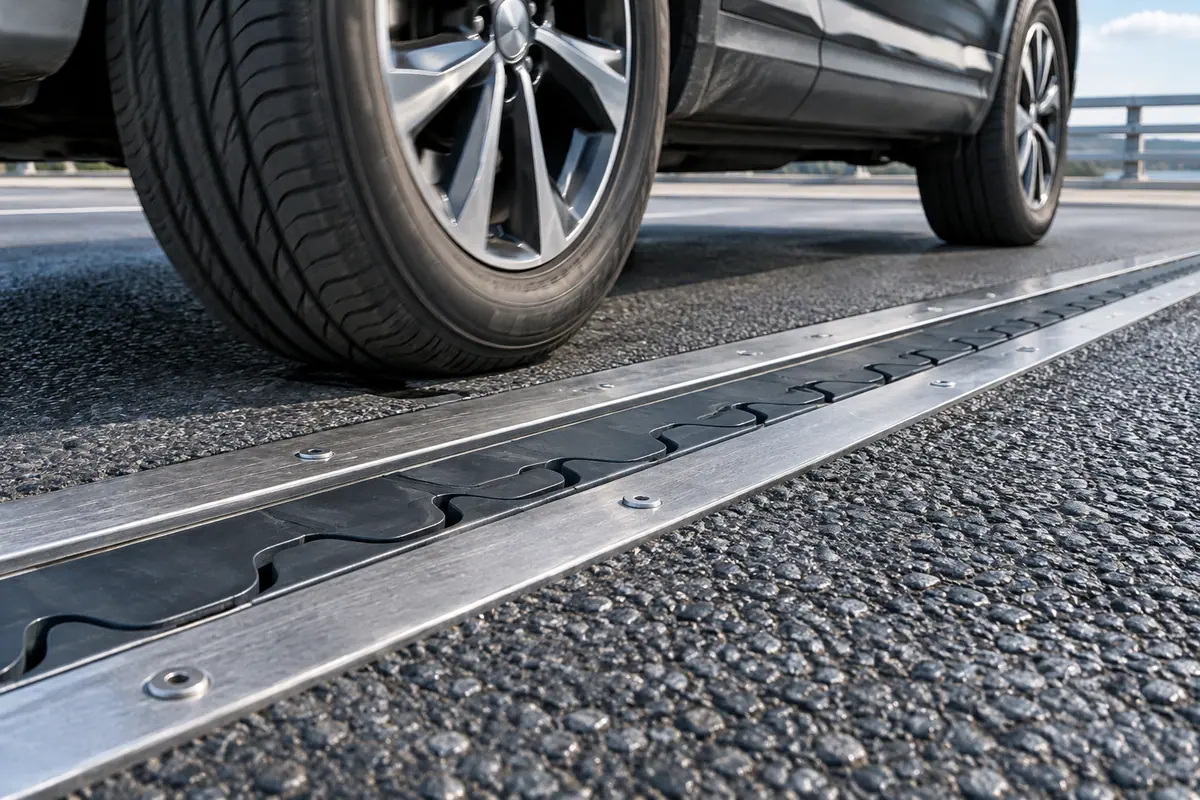
An expansion joint creates a deliberate gap or flexible zone where adjacent parts of the bridge can move relative to one another. The joint is not an empty hole left by accident. It is an engineered assembly that may include metal edges, seals, sliding surfaces, flexible materials and devices that transfer traffic loads across the opening.
The size and direction of movement are calculated during design. A straight, narrow bridge may mainly expand and contract along its length. A wide, curved or skewed bridge can also move sideways or along angled paths. The Federal Highway Administration notes that bearing orientation matters because it guides thermal movement and helps reduce unwanted forces.

Why do you sometimes feel a bump?
When a vehicle passes over an expansion joint, its tyres cross from one section of pavement to another. Even a well-maintained joint can produce a faint thump because the surface is interrupted by a narrow movement gap and a load-transfer system.
The joint must perform two jobs that pull in opposite directions. It must be flexible enough to open and close as the bridge moves, but strong enough to carry repeated wheel loads. It must also keep the driving surface reasonably smooth and prevent water, grit and de-icing chemicals from reaching vulnerable parts of the structure.
Different joint systems are suited to different movement ranges. One common type is a strip-seal joint, which uses a flexible seal held between metal shapes. Other systems use interlocking metal fingers or larger movement assemblies. Federal guidance gives an example of strip-seal joints accommodating roughly 100 millimetres of total thermal movement, with spacing between joints depending on the bridge design and climate.
The joint is therefore a compromise between movement capacity, durability, ride quality, construction complexity and maintenance. A joint that is too small may be unable to accommodate the bridge’s movement. One that is unnecessarily large may be more expensive and more difficult to maintain.
What do bearings have to do with it?
Expansion joints are usually part of a larger movement system. Bridge bearings support the superstructure while allowing it to rotate or translate in controlled ways. Some bearings are fixed in a particular direction, while others allow movement along a guided path.
The joint at the roadway is the part people notice, but the bearings underneath help determine how the bridge actually moves. Engineers choose a point or region where movement is restrained and arrange other supports so expansion is distributed in a predictable way. On curved or skewed bridges, this geometry becomes especially important because the movement is not simply straight forwards and backwards.
If bearings or restraints prevent the movement that the design expects, forces can become much larger. The Federal Highway Administration warns that excessive reactions and distortions may occur when bearings cannot accommodate the deflections and rotations caused by temperature changes. A joint alone cannot solve a problem created by a poorly coordinated support system.
Why not build every bridge without joints?
Expansion joints are useful, but they are also among the more troublesome parts of a bridge. They are exposed to traffic, weather, water, dirt and repeated impact. If a seal fails, water can leak through the deck and reach concrete beam ends, steel components, bearings and supporting elements.
Because of this, many modern bridge designs try to reduce the number of joints. Continuous girders can carry a bridge across several spans without a joint at every support. Jointless or integral-abutment bridges allow some thermal movement to be absorbed through the movement of the abutments and connected parts of the structure instead of through an exposed deck joint.
Eliminating a joint does not eliminate movement. It changes where that movement is accommodated. A jointless bridge must be designed so that the soil, abutments, bearings, deck and approach road can work together. Federal research describes integral and semi-integral abutments as ways of taking up thermally induced movement while avoiding some of the maintenance and corrosion problems associated with conventional deck joints.
The choice depends on span length, materials, temperature range, bridge geometry, ground conditions, expected traffic and maintenance requirements. In some situations, a conventional joint remains the most practical solution. In others, a jointless arrangement can provide a smoother and more durable bridge.
Why do expansion joints need maintenance?
Every time a vehicle crosses a joint, the assembly experiences a small impact and vibration. Over many years, that repeated loading can loosen components, damage seals or break away surrounding concrete. Water and grit can then enter the joint and accelerate deterioration.
Maintenance crews may clean the joint, repair concrete around it, replace seals or renew the complete assembly. Construction guidance also emphasises installation details such as protecting joints from damage before they are installed, allowing for the temperature at installation and checking that the opening has the correct width.
A joint that appears to be only a narrow line across the road can therefore be connected to a substantial maintenance task. Its condition matters not just for comfort but for the durability of the whole bridge. Leaking joints have been associated with deterioration of decks, beam ends, steel elements, bearings and substructure components.
That is why bridge owners generally prefer to use as few joints as the structure can safely manage. The goal is not to prevent movement. The goal is to let the bridge move in a controlled, accessible and durable way.
What to remember
- Bridge materials expand when warmed and contract when cooled, so long structures need a way to accommodate movement.
- Expansion joints create controlled movement zones while allowing vehicles to travel across the gap.
- Bearings underneath the bridge guide or permit movement and work together with the deck joint.
- Joints must carry traffic, keep out water and survive repeated movement, making them important maintenance points.
- Many newer bridges minimise or eliminate deck joints, but the movement still has to be absorbed somewhere in the design.
Sources & further reading
Where this story comes from
- Engineering Design, Fabrication, and Erection of Prefabricated Bridge Elements and SystemsFederal Highway Administration, US Department of Transportation
- LRFD for Highway Bridge Superstructures Reference ManualFederal Highway Administration, US Department of Transportation
- Bridge Geometry ManualFederal Highway Administration, US Department of Transportation
- Long-Term Bridge Performance: High Priority Bridge Performance IssuesFederal Highway Administration, US Department of Transportation
- Review Guidelines for Bridge Expansion Joints and Jointless BridgesFederal Highway Administration, US Department of Transportation
This story was researched, drafted and illustrated with AI, then automatically checked against ANTB's structural and sourcing rules. Use the linked primary and institutional sources to verify important details.
 How things work · 5 min read
 How things work · 6 min read
 How things work · 6 min read