
In this story
Cold is not something the refrigerator makes
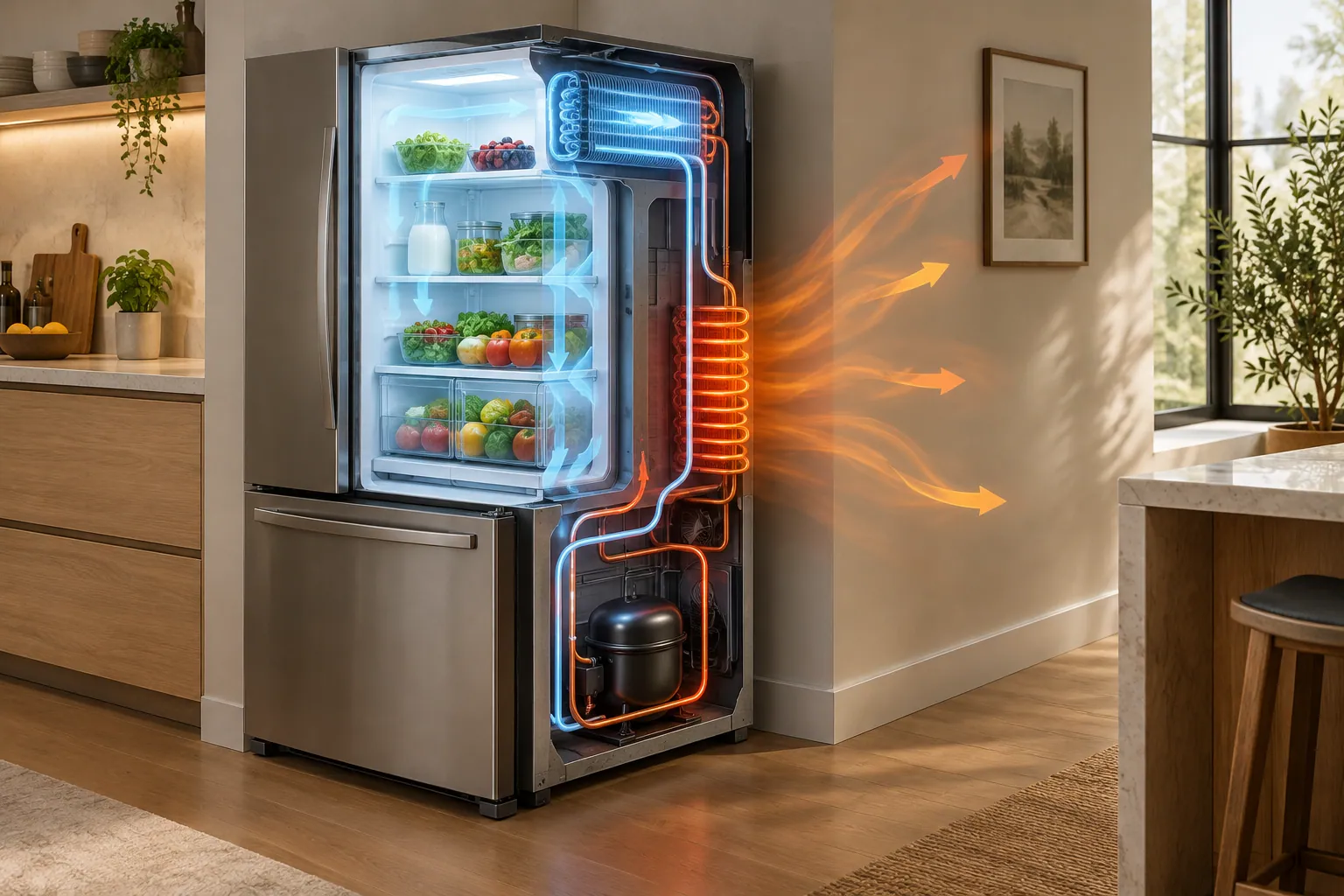
It is tempting to think of a refrigerator as producing cold in the same way that a kettle produces hot water. A better description is that it removes thermal energy. The food compartment becomes colder because heat leaves it, while the surrounding kitchen receives that heat.
This is why the outside of a working refrigerator can feel warm, particularly around the condenser coils or near the sides of the cabinet. The appliance is releasing the heat it has taken from inside, along with the electrical energy used to run its compressor. In thermodynamic terms, the refrigerator is a small heat pump operating in reverse to a heater: it transfers heat against its natural tendency to flow from warm areas to cool ones.
The usual domestic system is a sealed vapour-compression cycle. Its main parts are a compressor, condenser, expansion device and evaporator. The refrigerant circulates through these parts without normally being used up. NASA and the US Department of Energy describe the same four-stage principle for refrigeration systems, although real appliances contain additional controls, fans, insulation and safety features.
Step one: the evaporator collects heat
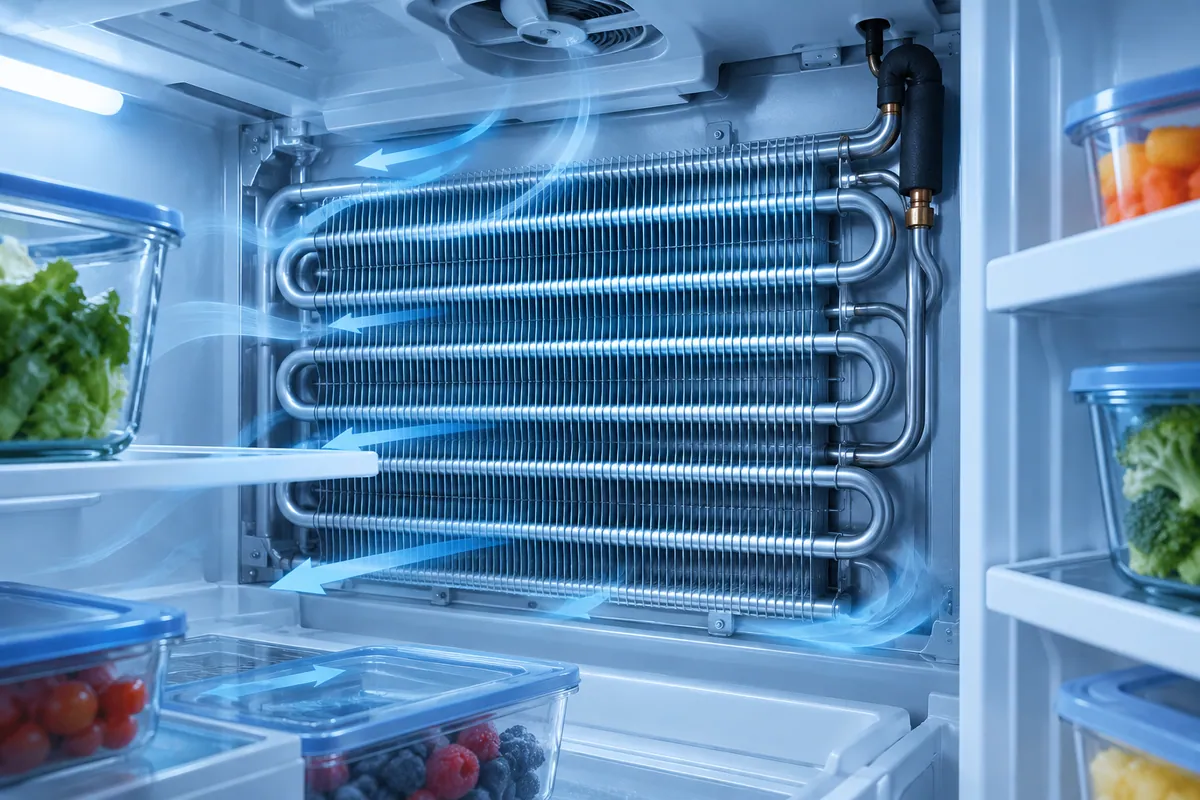
Inside the refrigerator cabinet, usually behind a panel, is the evaporator. Refrigerant enters it at low pressure as a very cold mixture of liquid and vapour. Because its pressure is low, the refrigerant can boil at a temperature below the temperature of the food compartment.
As the refrigerant changes from liquid to vapour, it absorbs heat from the air around the evaporator coils. A fan may circulate that cooled air through the refrigerator and freezer compartments. The important point is that the refrigerant is not simply becoming cold by itself: it is absorbing energy from the cabinet while it boils.
This phase change makes the process effective. A refrigerant can take in a substantial amount of heat while changing from liquid to gas, even when its temperature changes only modestly. Once it has absorbed enough heat, the refrigerant leaves the evaporator as a low-pressure gas and travels towards the compressor.
Step two: the compressor adds energy
The compressor is the part that consumes most of the refrigerator’s electrical power. It draws in the low-pressure refrigerant gas and squeezes it into a much smaller volume. Compression raises both the refrigerant’s pressure and its temperature.
The refrigerant now becomes a hot, high-pressure gas. This temperature increase is essential: to release heat into a kitchen that is already warmer than the cold interior, the refrigerant must be hotter than the surrounding room air. Without the compressor, the cycle could not continue in the required direction.
The compressor is controlled by the refrigerator’s temperature system. In a conventional appliance, it switches on when the compartment becomes too warm and switches off after the target temperature has been reached. Newer designs can use variable or adaptive compressors that adjust their output instead of simply operating at full power or stopping completely.
Step three: the condenser gets rid of the heat
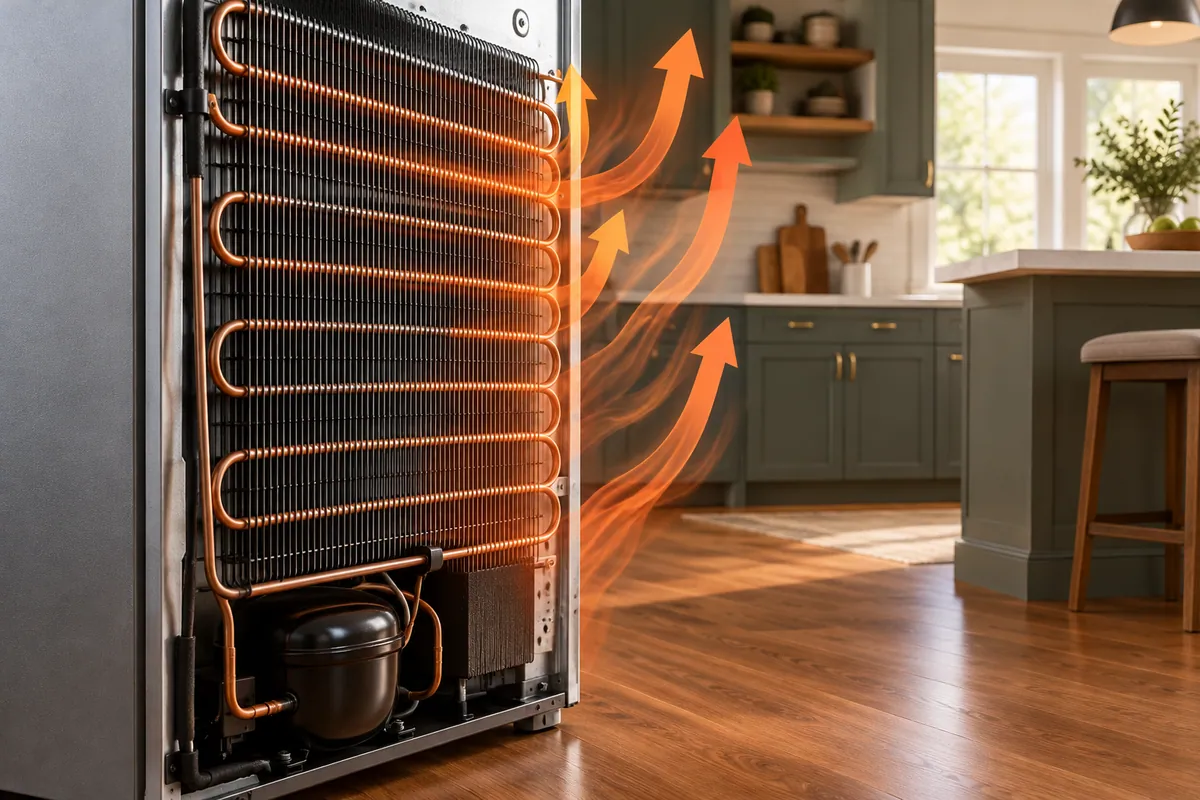
The hot refrigerant gas flows through the condenser, a set of tubes with fins that increase the surface area available for heat transfer. In many household refrigerators, the condenser is at the back, underneath or built into the cabinet walls. Air moving around these surfaces carries heat away into the room.
As the refrigerant loses heat, it condenses from a gas into a high-pressure liquid. This is the reverse of what happened in the evaporator: there, the refrigerant boiled and absorbed heat; here, it condenses and releases heat.
The heat leaving the condenser includes more than the heat removed from the food compartment. It also includes the electrical work supplied to the compressor. That is why standing beside a refrigerator can reveal a gentle flow of warm air, and why placing the appliance next to an oven or in direct sunlight can make it work harder. Good airflow around the cabinet helps the condenser release heat efficiently.
Step four: the expansion device resets the refrigerant
After the condenser, the refrigerant is a warm or moderately cool high-pressure liquid. It then passes through a narrow expansion device, such as a capillary tube or expansion valve. This restricts the flow and causes a sharp drop in pressure.
When the pressure falls, some of the liquid flashes into vapour. The refrigerant mixture becomes much colder, preparing it to enter the evaporator again. The expansion device does not remove heat in the same way as the evaporator; instead, it creates the low-pressure conditions that allow the refrigerant to boil at a low temperature in the evaporator.
The cycle then repeats: cold refrigerant absorbs heat inside, the compressor raises its pressure and temperature, the condenser releases heat outside, and the expansion device lowers its pressure again. The refrigerant itself travels around a closed loop, while heat is transferred from the cabinet to the room.
Why insulation and door seals matter
The refrigeration cycle can only maintain a low temperature if heat does not rush back into the cabinet. Thick insulation in the walls and doors slows heat transfer. Magnetic door seals reduce gaps around the opening, while shelves and internal air circulation help distribute temperature more evenly.
Every time the door opens, some cold air escapes and warmer, moisture-laden room air enters. The refrigerator must then remove that additional heat and often some of the moisture as well. Frost or ice can form when that moisture freezes, which is why frost-free models periodically run a defrost heater or another defrosting system.
A damaged seal, dirty condenser or poor airflow can therefore increase energy use. ENERGY STAR recommends checking door seals, allowing air to circulate around the appliance and keeping the refrigerator away from strong heat sources. These actions do not change the basic physics, but they reduce the amount of heat the system must remove.
What to remember
- A refrigerator moves heat; it does not manufacture cold.
- The evaporator absorbs heat inside the cabinet as the refrigerant boils.
- The compressor uses electricity to raise the refrigerant’s pressure and temperature.
- The condenser releases the collected heat into the room.
- The expansion device lowers the refrigerant’s pressure so it can become cold again.
- Insulation, door seals and airflow reduce the work required from the refrigeration cycle.
Sources & further reading
Where this story comes from
- Vapor Cycles: Vapor Compression Refrigeration CycleNational Aeronautics and Space Administration Technical Reports Server
- Refrigeration SystemsENERGY STAR and the US Department of Energy
- RefrigeratorsENERGY STAR
- TFAWS Cryo Course: Fundamentals of RefrigerationNational Aeronautics and Space Administration
- High-Efficiency Refrigerator with Cold Energy Storage Enabling Demand FlexibilityUS Department of Energy
This story was researched, drafted and illustrated with AI, then automatically checked against ANTB's structural and sourcing rules. Use the linked primary and institutional sources to verify important details.
 How things work · 5 min read
 How things work · 6 min read
 How things work · 6 min read