

In this story
A book is more chemically active than it looks
A book may appear solid and stable, but its materials continue to change slowly. Paper contains cellulose fibres and, depending on how it was made, varying amounts of lignin, rosin and other substances. A bound volume may also contain animal or synthetic adhesives, inks, cloth, leather, boards, coatings and residues absorbed from the surrounding air.
As these materials age, some of their molecules become small and volatile enough to escape from the paper or binding. Volatile organic compounds are chemicals that can enter the air under ordinary conditions. When they reach the nose, they are interpreted as odours. The smell of a book is therefore partly the smell of its materials ageing in place.
The exact mixture differs from book to book. A nineteenth-century volume printed on one kind of paper and stored in a dry library will not smell exactly like a twentieth-century paperback kept in a damp house. Researchers can use the volatile compounds emitted by paper as clues about its composition and condition.
Why vanilla, grass and wood are common descriptions
The classic scent of an old book is often described using words such as vanilla, caramel, grass, wood, chocolate or almonds. These descriptions are not proof that the book contains those foods or fragrances. They are human comparisons for the way particular airborne chemicals are perceived.
One important source is lignin, a complex component of wood. Paper manufacturers can remove much of it during processing, but papers made from some wood pulps retain more than others. As lignin and related substances oxidise and break down, they contribute to the colour change and odour associated with ageing paper. Some products of this chemistry can produce sweet or vanilla-like impressions, while others add woody, grassy or earthy notes.
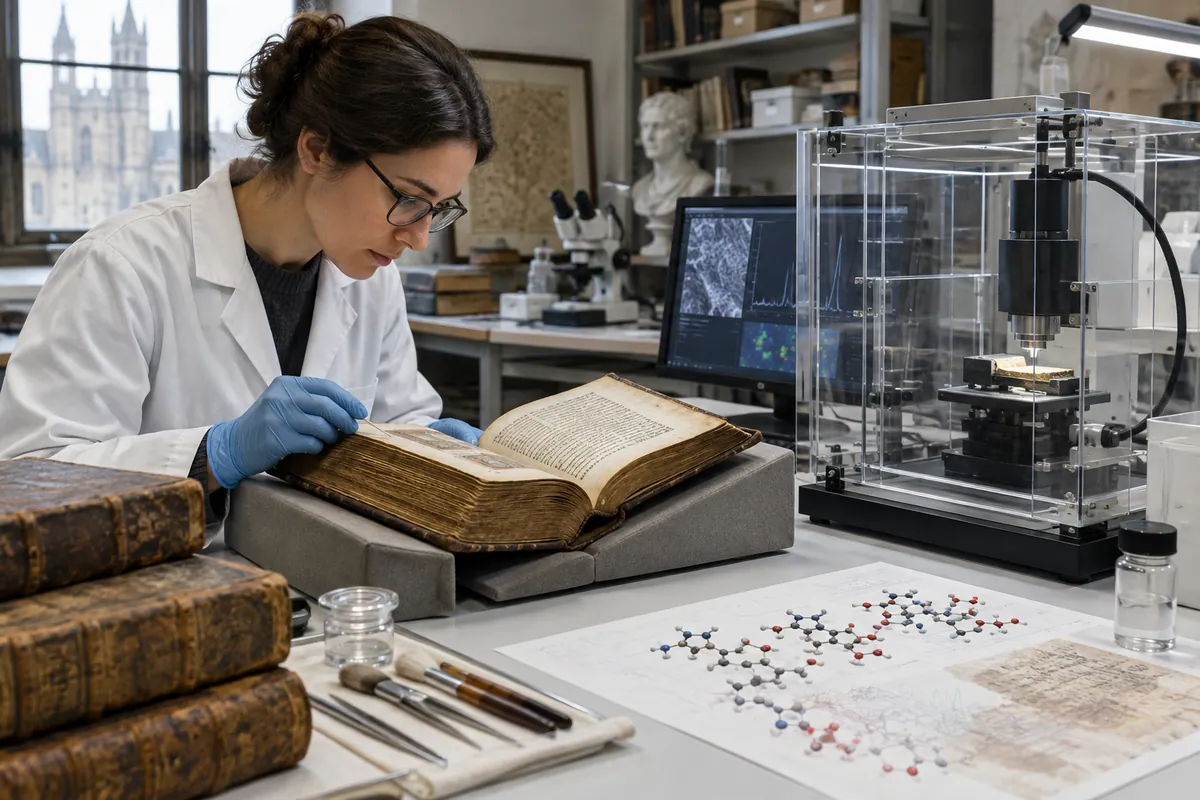
Cellulose and rosin-related materials also contribute to the chemical profile. Scientific analysis of historic paper has identified acetic acid, furfural and other volatile degradation products among the compounds associated with the smell. No single compound explains every old book: the recognisable aroma comes from the combined effect of many compounds released in very small quantities.
Why some old books smell musty
“Old book smell” and “musty smell” are related but not identical. The characteristic aroma of ageing paper can appear even when a book has been kept in reasonable conditions. A musty odour, by contrast, often suggests that the book has spent time in a damp or poorly ventilated environment, where moisture and microbial activity may have affected the paper, boards, textiles or dust around it.
Storage conditions influence both the speed of chemical degradation and the odours that remain trapped inside a book. Heat, moisture, pollutants and contact with unsuitable materials can all affect preservation. A book stored in a closed case may accumulate volatile compounds between its pages, making the scent seem stronger when it is opened.
The smell alone cannot provide a complete diagnosis. Conservation scientists analyse volatile compounds as one possible, non-destructive source of information, but a conservator would also consider visible staining, distortion, brittleness, mould, insect damage and the book’s storage history. A sweet or woody smell is not automatically a sign that a book is healthy, and a musty smell is not automatically proof of active mould.
Why opening the book releases the smell
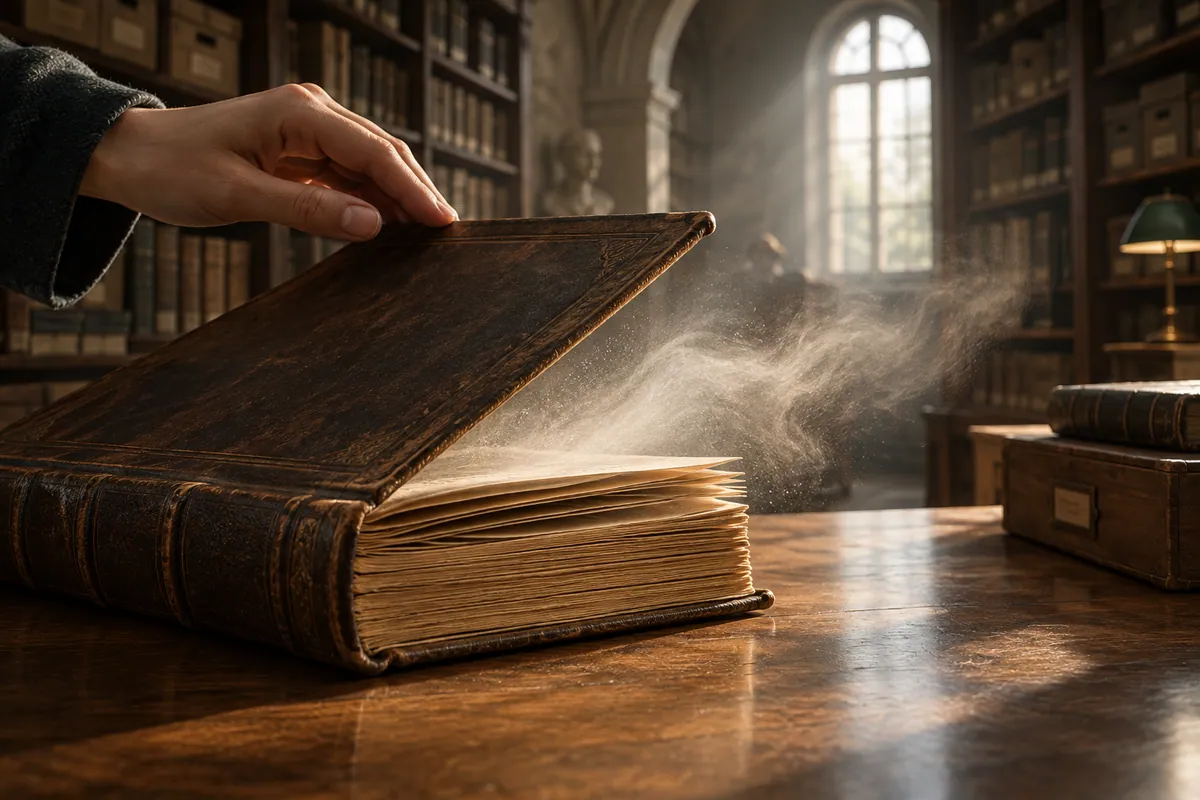
A closed book acts a little like a collection of narrow, sheltered spaces. Its pages and covers present a large amount of surface area, while the binding restricts air movement. Volatile molecules can build up in these small spaces over time. Opening and fanning the pages replaces the still air with fresh air, carrying those molecules towards the nose.
This is also why the smell may seem stronger in an older or rarely opened book. The book may have retained compounds for years, and opening it suddenly exposes them. The Library of Congress has noted that the ageing behaviour of paper inside a bound book differs from the behaviour of a single sheet exposed to continuously moving air. The physical form of the book changes how its degradation products are held and released.
The effect is temporary as well as cumulative. Some volatile compounds disperse quickly after the book is opened, while others continue to be released from the paper and binding. Temperature and humidity can also change how readily substances move into the air.
Why new books smell different
New books can smell strong for a related reason: their materials are releasing VOCs from manufacturing and finishing processes rather than mainly from decades of degradation. Fresh paper, printing inks, coatings, adhesives and binding materials each have their own emissions. The smell may be sharper, more solvent-like or more resinous than the softer aroma of an old volume.
Modern paper is not chemically uniform. Different fibres, pulping methods, bleaching treatments, coatings and adhesives produce different odour profiles. Two books published in the same year can smell different if they use different paper stocks, inks or bindings.
As the book ages, the balance changes. Some manufacturing-related compounds dissipate, while slow reactions in paper and other organic materials produce new degradation compounds. The book’s environment also leaves a trace: smoke, cooking, perfume, cleaning products and damp storage can all be absorbed or deposited over time. In this sense, a book’s scent can record both what it is made of and where it has been.
Can smell help preserve books?
Yes, but mainly as one part of a wider conservation process. Research into book odours has shown that volatile compounds can reveal information about paper composition and degradation. Because sampling can be performed without cutting into or dissolving the object, odour analysis is potentially useful for rare books and archival collections.
Conservators have also created tools such as the Historic Book Odour Wheel, which links sensory descriptions with chemical and material information. These systems do not turn smell into an exact age calculator. Instead, they help record the condition and character of objects in a consistent way.
The smell of books can also be treated as part of cultural heritage. A library is not only a place of printed information; it is an environment with characteristic materials, air and sensory experiences. Researchers have therefore explored ways to document historic odours and, in some cases, create careful conceptual reconstructions for exhibitions. Such reconstructions are interpretations of a material history, not literal proof that every book or library smelled the same.
What to remember
- The smell of an old book is a mixture of volatile organic compounds released by ageing paper and other materials.
- Lignin, cellulose, rosin, adhesives, inks, leather, dust and storage conditions can all influence the final aroma.
- Vanilla-like, grassy, woody and earthy descriptions refer to the way people perceive groups of chemicals, not to one single “old book” molecule.
- A musty smell may point to damp storage or microbial effects, but smell alone cannot diagnose a book’s condition.
- Conservators can study airborne compounds as a non-destructive clue to paper composition and degradation.
- Book odours can be culturally meaningful because they preserve an association with particular collections, buildings and memories.
Sources & further reading
Where this story comes from
- Book and Paper: Volatile Organic Compound TestingLibrary of Congress
- Volatile Organic Compounds (VOCs) – The Scent of Our Collections and the Things That Hold ThemLibrary of Congress
- Material Degradomics: On the Smell of Old BooksAmerican Chemical Society
- The Science Behind the Smell of Books, Explained by PreservationUniversity of Colorado Boulder Libraries
- The Smell of Heritage: A Framework for the Identification, Analysis and Archival of Historic OdoursHeritage Science
- Accelerated Aging of Paper: Can it Really Foretell the Permanence of PaperLibrary of Congress
- Research Guides: Preserving Your Books: IntroductionLibrary of Congress
This story was researched, drafted and illustrated with AI, then automatically checked against ANTB's structural and sourcing rules. Use the linked primary and institutional sources to verify important details.
 How things work · 5 min read
 How things work · 6 min read
 How things work · 6 min read