
In this story
What is actually happening when you pull the tab?
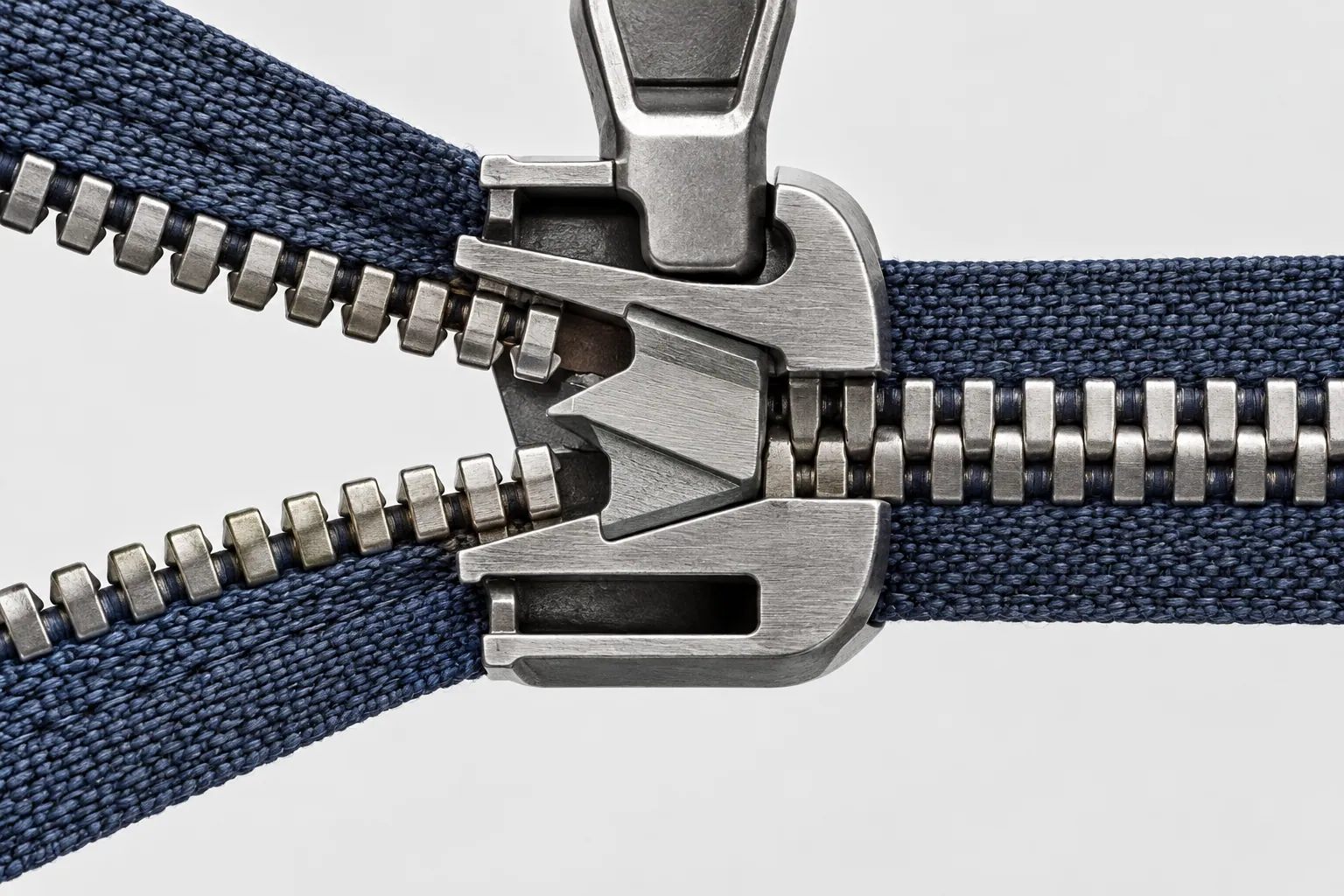
A zip fastener has several main parts: two fabric tapes, rows of teeth or coils attached to those tapes, and a slider with a pull tab. The slider is the moving metal or plastic piece. The pull tab gives your fingers leverage, but it is the slider’s internal shape that does the real work.
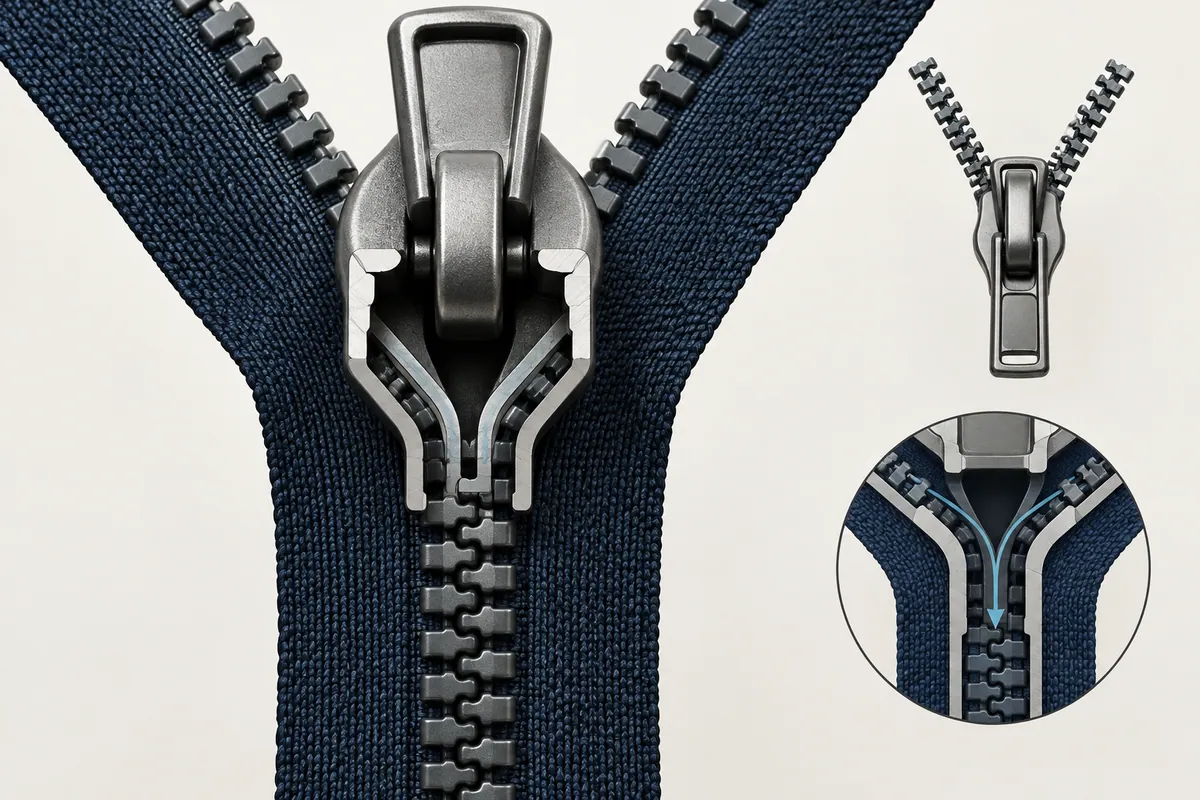
When the slider moves upwards, it does not simply push the teeth together as though they were buttons. The slider has channels that divide and then reunite the two rows. At the lower end, the rows enter separately. As they travel through the slider, they are guided towards one another. At the narrower section, the teeth meet in the correct position and interlock. The joined teeth then leave through the upper end as a single line.
This arrangement is often described as a Y-shaped path. The two legs of the Y receive the separate rows, while the stem carries the engaged rows away from the slider. The geometry means that the slider performs a series of tiny alignment operations, one tooth at a time, rather than fastening the entire length in one movement.
Why do the teeth not simply pull apart?
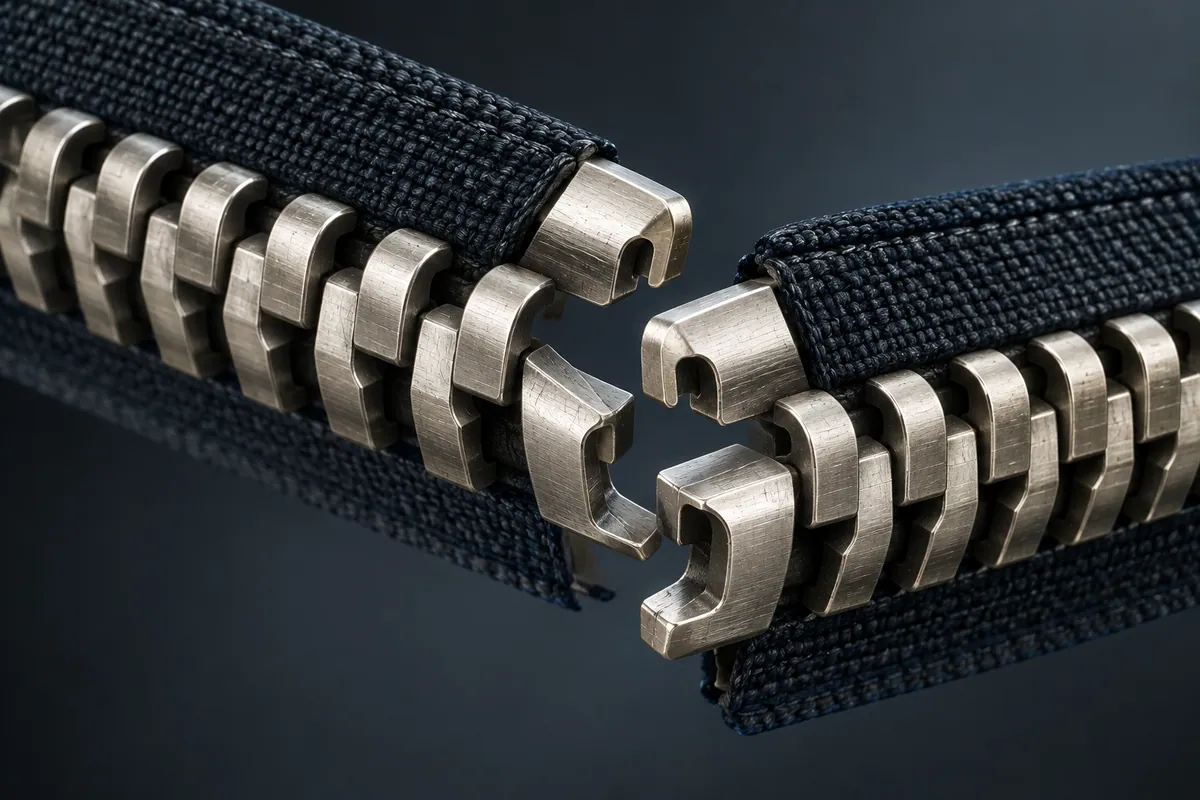
The teeth are shaped so that neighbouring pieces grip one another. Depending on the type of fastener, they may be made from metal, moulded plastic or a continuous synthetic coil. Their precise shapes vary, but the important principle is the same: each element on one side occupies a matching space on the other side.
When the two rows are interlocked, a sideways pull has to force many teeth out of their matching positions at once. The load is distributed along the fastener rather than concentrated at a single button or hook. The fabric tapes also spread the force into the surrounding garment, bag or piece of equipment.
A zip fastener is therefore strongest when the two sides are aligned and the slider has brought the teeth fully together. If the fabric is twisted, the teeth are damaged or the slider is partly open, the forces are no longer shared evenly. That is why a zip can appear closed near the top but split open below the slider: the teeth were not properly engaged, or the slider was unable to hold them in the correct relationship.
What does the slider’s shape do?
The slider is a small wedge-shaped guide. Its internal channels are wide enough to admit the two separate rows but narrow enough to bring them into alignment. The slider must also leave sufficient clearance for the engaged teeth to pass through without jamming.
This is a delicate compromise. If the slider is too loose, it may fail to press the teeth together firmly enough. If it is too tight, the fastener may become difficult to operate or the teeth may be forced out of position. The design therefore depends on consistent tooth dimensions, accurate spacing and a slider manufactured to match them.
The pull tab changes how you apply force. Pulling along the direction of the fastener moves the slider through its intended path. Pulling sharply sideways can twist the slider or load only one side of the teeth. That can make a fastener catch, split or become permanently distorted.
Why does a zip sometimes split open behind the slider?
A splitting zip is often a mechanical problem rather than a mysterious failure. The slider may have become worn or slightly spread, leaving too much space between its internal surfaces. In that condition it may move along the rows without pressing the teeth together tightly enough.
The teeth themselves may also be bent, missing or contaminated with grit. A damaged tooth cannot present the correct shape to its partner, so the interlocking sequence breaks down. Misalignment at the bottom of a separating fastener can have a similar effect: if the starting pin and the slider are not fully inserted, the two rows may enter the slider unevenly.
These explanations describe the mechanism, not a universal repair rule. Different fasteners use different tooth profiles and slider designs, so a repair that works on a jacket may damage a tent, luggage case or waterproof garment. The safest general principle is to avoid forcing the pull tab when the rows are visibly misaligned.
Why are there different kinds of zip fastener?
Metal fasteners use individual teeth formed from materials such as aluminium, brass or other alloys. Moulded-plastic fasteners use separate teeth made from polymer, while coil fasteners use a continuous spiral element. All three types rely on the same broad idea: the slider brings two flexible rows into a controlled interlocking relationship.
A separating fastener, such as the one commonly used on a jacket, has a bottom arrangement that allows the two sides to come apart completely. A closed-end fastener, such as one often used on trousers, pockets or cushions, keeps the two rows attached at one end. Two-way fasteners add sliders or openings that allow movement from more than one direction.
Water-resistant designs use additional construction features to reduce the passage of water through the fastener. Their performance depends not only on the teeth and slider but also on the coating, tape, sealing arrangement and how the fastener is sewn into the product. A zip described as water-resistant is not automatically identical to a fully waterproof closure.
How did the modern zip fastener develop?
The modern zip fastener was developed from several earlier attempts to create a quicker alternative to buttons, hooks and boot laces. American inventor Whitcomb Judson patented a device called a clasp locker in 1893. It used a row of hooks and eyes and was intended initially as a shoe fastener, but early versions were prone to jamming and opening unexpectedly.
Gideon Sundback, an engineer working with the company that developed Judson’s device, redesigned the arrangement. His later fastener used two rows of closely spaced interlocking elements and a slider, producing the basic form recognisable today. A 1917 patent for a separable fastener described a design that could be opened completely and used on garments and other articles.
The familiar English word “zipper” came later. The B.F. Goodrich Company used the word when marketing rubber overshoes fitted with the fastener in the 1920s, apparently referring to the sound and speed of the device. The name gradually became the ordinary term in American English, while “zip” remains common in British and Australian English.
What to remember
- The slider is the active mechanism: it guides, aligns and presses the two rows of elements together.
- Interlocking teeth resist separation because a sideways pull would have to disengage many matching elements at once.
- A zip can split when the slider is worn, the teeth are damaged, or the two sides enter the slider out of alignment.
- Metal, moulded-plastic and coil fasteners use different components but share the same basic operating principle.
- The modern zip developed through several nineteenth- and early twentieth-century designs rather than appearing as a single finished invention.
Sources & further reading
Where this story comes from
- Whitcomb JudsonLemelson-MIT Program
- The Up and Down History of the ZipperSmithsonian Libraries and Archives
- History of the ZipperYKK Americas
- A zip fastenerGoogle Patents
- Gideon Sundback Invented the Modern Day ZipperNational Inventors Hall of Fame
This story was researched, drafted and illustrated with AI, then automatically checked against ANTB's structural and sourcing rules. Use the linked primary and institutional sources to verify important details.
 How things work · 5 min read
 How things work · 6 min read
 How things work · 6 min read