
In this story
It detects smoke, not fire itself
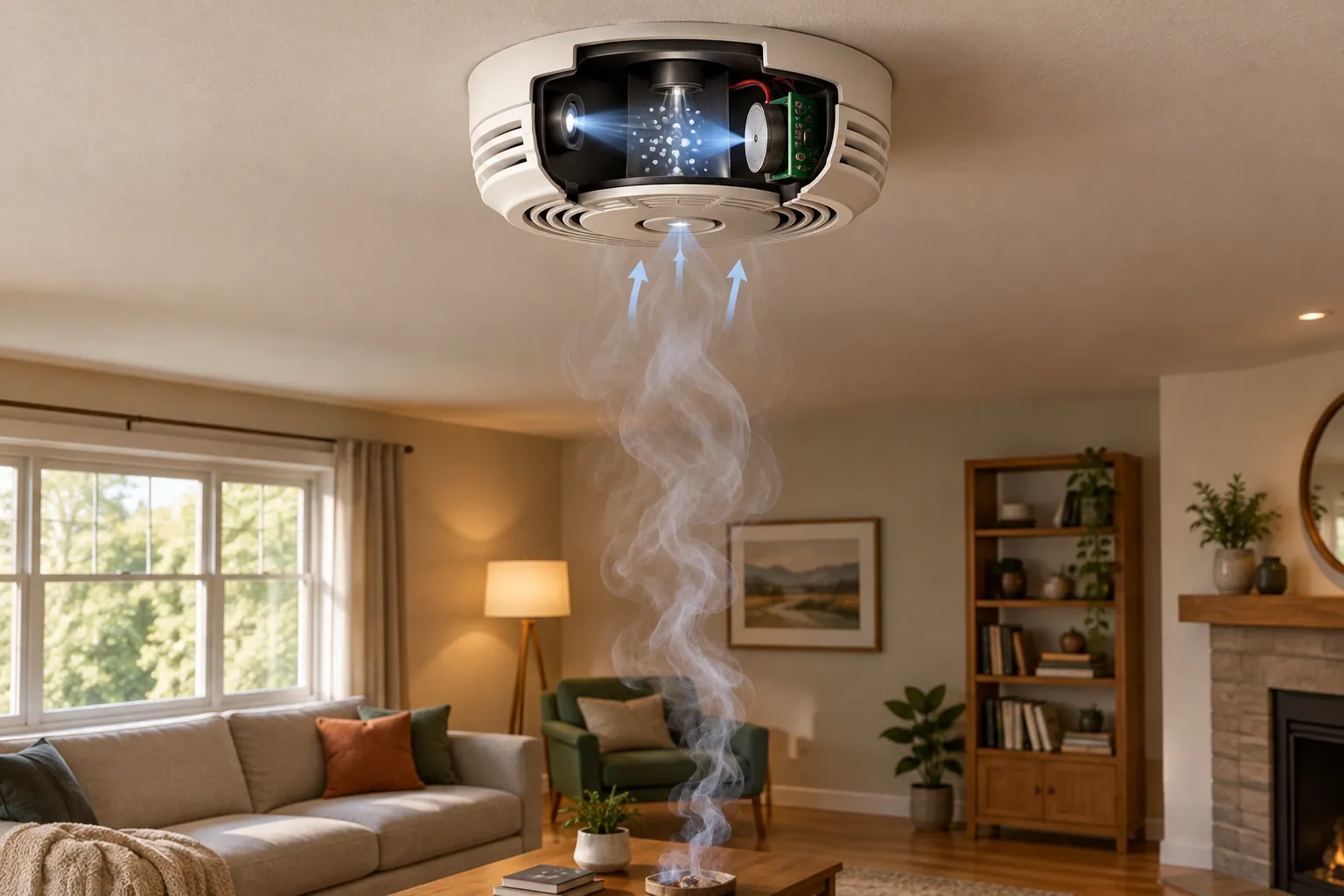
The familiar ceiling-mounted device is more accurately called a smoke alarm than a fire detector. Its job is not to look for flames, measure room temperature or identify every dangerous gas. A standard smoke alarm senses particles produced by combustion that have entered its sensing chamber.
That distinction explains both its usefulness and its limitations. A fire may begin with a long, smoky smoulder before flames appear, or it may develop rapidly into a flaming fire. The particles produced in those two situations can differ in size, colour and concentration, so no single sensing method responds identically to every fire.
A standard smoke alarm also does not normally detect carbon monoxide or heat. Those hazards require different sensing technologies or a separate carbon-monoxide alarm.
How an ionisation alarm works
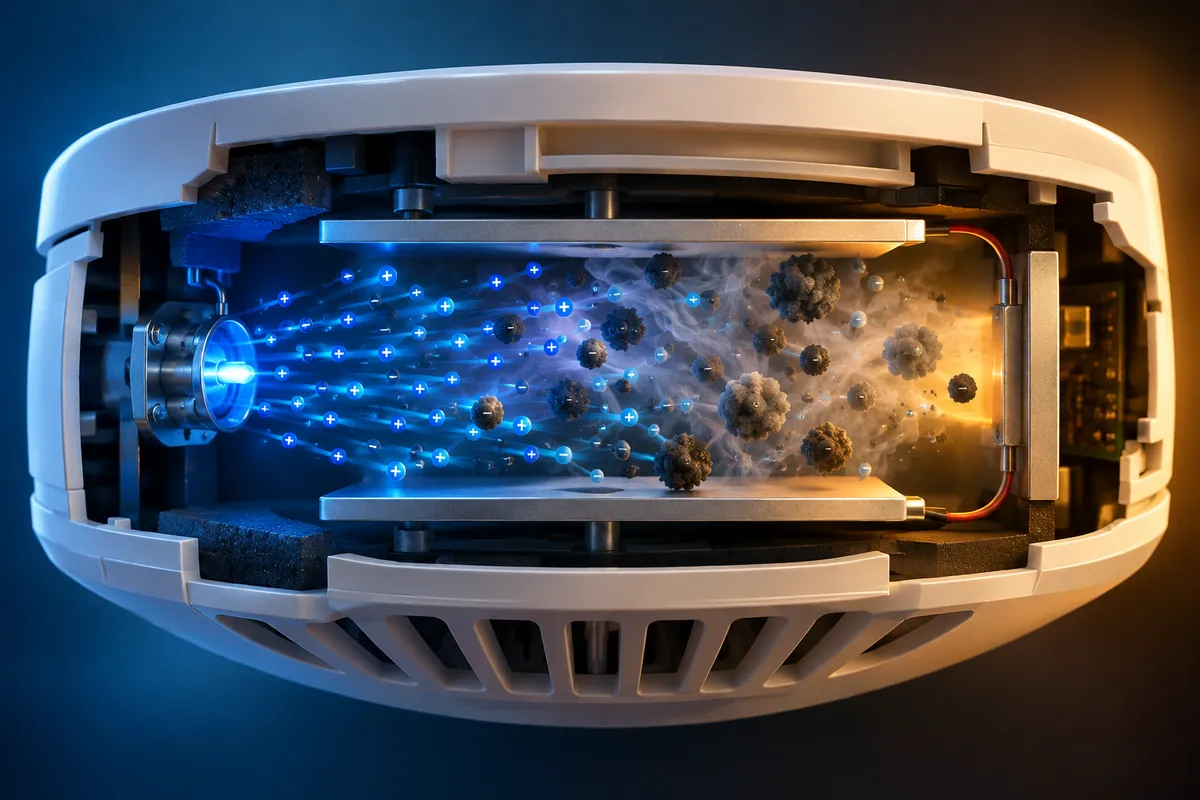
An ionisation alarm contains a sensing chamber with two electrically charged plates and a small, safely shielded radioactive source. The source ionises some of the air molecules between the plates, allowing a small electrical current to flow.
When smoke particles enter the chamber, they attach to ions and interfere with their movement. The electrical current falls. If it drops far enough, the alarm’s electronic circuit interprets the change as smoke and activates the sounder.
Ionisation sensing is generally more responsive to the small particles commonly associated with rapidly flaming fires. It is not a guarantee of earlier warning in every flaming fire, because the result also depends on the fuel, ventilation, alarm location and how the fire develops. Research tests have found that the difference between alarm types can be small in some scenarios and substantial in others.
How a photoelectric alarm works
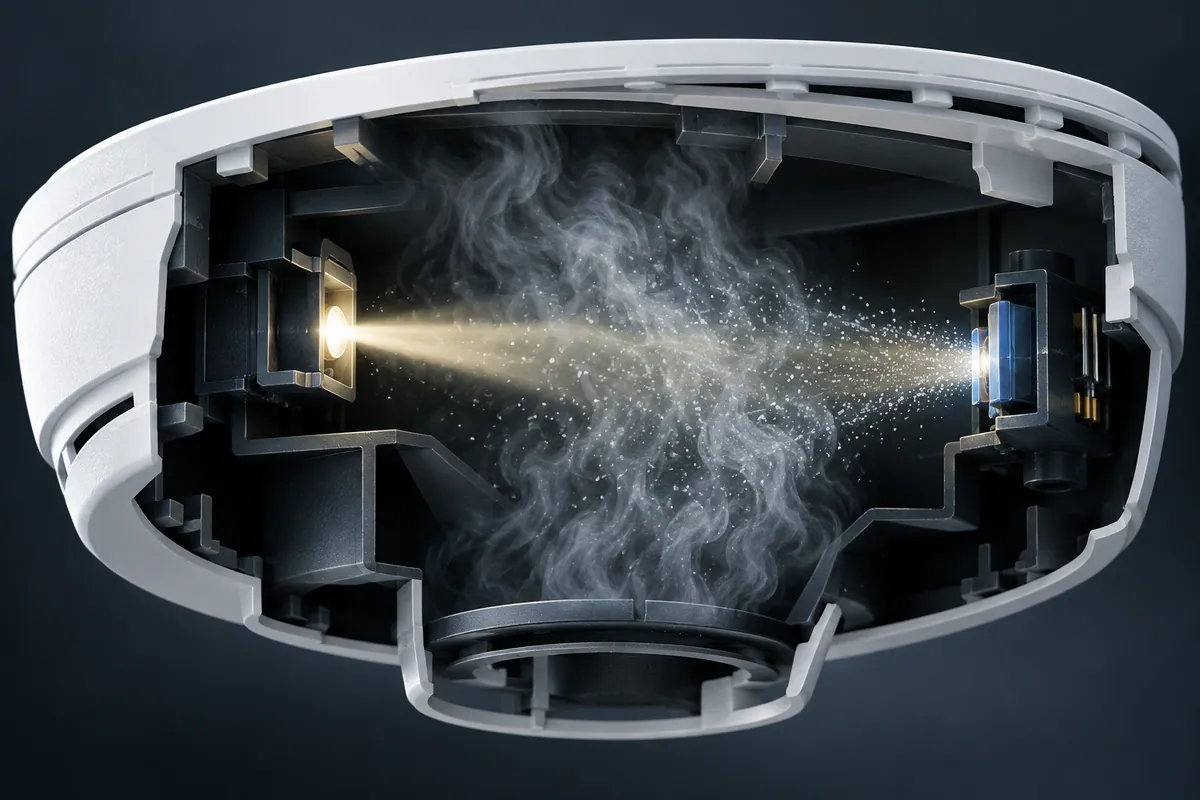
A photoelectric alarm uses a light source and a light sensor inside a sensing chamber. The light beam is arranged so that, in clean air, it does not shine directly onto the sensor.
When smoke enters, its particles scatter or reflect some of the light. The sensor receives that scattered light and sends a signal to the alarm’s electronics. Once the signal reaches the device’s threshold, the alarm sounds.
Photoelectric sensing is generally more responsive to the larger particles often produced by slow, smouldering fires. These can occur when materials such as upholstered furniture or bedding heat and decompose without bursting into flames immediately. In such conditions, a photoelectric alarm may respond considerably sooner than an ionisation alarm, although actual performance varies with the fire and the installation.
Why alarms sometimes sound while you are cooking
The sensing chamber cannot automatically understand the difference between dangerous fire smoke and every harmless airborne particle. Cooking aerosols, steam, dust and other particles can enter the chamber and produce a signal similar to smoke.
This is a design trade-off. If an alarm were made insensitive to all nuisance particles, it could also become slower to respond to a real fire. If it were made sensitive to every small change in the air, it could sound so often during ordinary household activities that people might remove its battery or ignore it.
Research by the National Institute of Standards and Technology has examined alarms exposed to activities such as toasting, frying, baking and broiling. The likelihood of a nuisance alarm generally falls as the alarm is placed farther from the cooking source. The U.S. Fire Administration advises using a hush feature when appropriate rather than removing the battery or disabling the alarm.
Why many homes use both types
Ionisation and photoelectric alarms are not rivals detecting exactly the same thing. They respond to different physical changes and tend to have different strengths. Ionisation alarms are generally quicker with the small particles of many flaming fires, while photoelectric alarms are generally quicker with the larger particles of many smouldering fires.
Because nobody can predict where a household fire will begin or whether it will smoulder or flame first, the U.S. Fire Administration recommends either installing both types or using a dual-sensor alarm that contains both technologies. A dual-sensor alarm can respond through either sensing principle, rather than relying on only one kind of evidence.
This recommendation should not be read as meaning that every dual-sensor alarm will always sound first. Fire growth, room layout, air movement, alarm position and the materials burning all affect how quickly smoke reaches the sensor. The established point is narrower: combining technologies provides broader coverage across different fire scenarios.
The alarm needs to be in the right place
A technically good alarm cannot warn people effectively if smoke takes too long to reach it, or if it is missing from the room where people sleep. The U.S. Fire Administration recommends alarms inside bedrooms, outside each separate sleeping area and on every level of a home, including the basement. It also recommends interconnected alarms, so that when one detects smoke, all connected alarms sound.
Smoke rises and alarms are therefore commonly installed on ceilings or high on walls, subject to the manufacturer’s instructions. Exact placement matters: an alarm close to a kitchen may be more prone to nuisance alarms, while an alarm too far from a fire may provide less escape time.
A smoke alarm is an early-warning device, not a promise that there will always be ample time to escape. NIST testing found that both major alarm types can provide escape time in many residential fire scenarios, but that available time can sometimes be short. Modern furnishings and other fuel loads can also contribute to rapid fire development.
What to remember
- A smoke alarm senses combustion particles rather than flames directly.
- Ionisation alarms measure a change in electrical current; photoelectric alarms measure scattered light.
- Ionisation sensing generally favours rapidly flaming fires, while photoelectric sensing generally favours smouldering fires.
- Cooking, steam and dust can trigger nuisance alarms because the sensor responds to particles, not intent.
- For broad coverage, official fire-safety guidance recommends both sensing technologies or a dual-sensor alarm.
- Test alarms monthly, follow the manufacturer’s instructions and replace an alarm around 10 years from its manufacture date.
Sources & further reading
Where this story comes from
- How Do Smoke Detectors Work?National Institute of Standards and Technology
- Smoke AlarmsU.S. Fire Administration
- U.S. Fire Administration Position StatementsU.S. Fire Administration
- Smoke Alarms in US Home FiresNational Fire Protection Association
- Results from a Full-Scale Smoke Alarm Sensitivity StudyNational Institute of Standards and Technology
- Smoke Alarm ResearchNational Institute of Standards and Technology
- Fire Safety Information CenterU.S. Consumer Product Safety Commission
This story was researched, drafted and illustrated with AI, then automatically checked against ANTB's structural and sourcing rules. Use the linked primary and institutional sources to verify important details.
 How things work · 6 min read
 How things work · 6 min read
 How things work · 6 min read