

In this story
Floating is a question of density
A floating object does not need to be light in an everyday sense. What matters is its average density: how much mass is packed into a given volume. A solid block of wood can float, while a small metal coin sinks, because the wood has a lower average density than water and the metal has a higher one.
The basic rule is described by Archimedes’ principle. A fluid pushes upwards on an immersed object with a force equal to the weight of the fluid displaced by that object. If the object’s average density is lower than the surrounding fluid, it can displace enough fluid to support its own weight before it is completely submerged. If its density is greater, it must sink. This is why a steel ship can float even though steel itself is denser than water: the ship’s hollow shape includes enough air that its average density is lower than that of the water it displaces.
Ice floats for the same reason. Ice is made of water, but its solid form occupies more volume for the same amount of material. That makes its average density lower than the density of liquid water. The result is familiar in a glass: an ice cube settles with part of its volume below the surface and part above it. The surrounding water supplies enough upward buoyant force to balance the cube’s weight.
A useful way to picture this is to imagine weighing the water displaced by the submerged part of the cube. The cube stops sinking when the displaced water weighs the same as the cube. Because ice is less dense than water, only part of the cube needs to be underwater to displace that amount.
What water molecules do when water freezes
The unusual behaviour begins with the shape and electrical character of a water molecule. Each molecule contains two hydrogen atoms and one oxygen atom. The oxygen side has a slight negative charge, while the hydrogen side has a slight positive charge. These opposite partial charges attract neighbouring molecules, creating interactions called hydrogen bonds.
In liquid water, the molecules are constantly moving. Hydrogen bonds form and break as the molecules slide past one another, so the arrangement is disordered and can change from moment to moment. The molecules can move relatively close together, leaving some of the spaces in their temporary network filled.
As liquid water cools, the molecules move less energetically. Near freezing, hydrogen bonds hold the molecules in a more organised arrangement. In ordinary ice formed at everyday pressure, the molecules settle into a crystal structure in which each water molecule is linked to neighbours in an open, roughly hexagonal network.
That network is the crucial detail. The hydrogen bonds do not pull every molecule into the tightest possible packing. Instead, they hold the molecules at angles that leave empty spaces within the structure. The molecules are, on average, farther apart in ice than in liquid water. The solid is therefore less dense, even though solids are usually more tightly packed than liquids.

Why freezing makes water expand
For most substances, cooling removes energy from the molecules, allowing them to move less and pack more closely. Their solid forms are consequently denser than their liquids. Water follows that pattern only down to about 4 degrees Celsius. Below that temperature, its density begins to decrease as the hydrogen-bonded structure becomes more open. When water freezes, it expands further.
The expansion is not caused by the water molecules themselves becoming larger. The molecules remain H2O molecules. Instead, their arrangement changes. In liquid water, the bonds are continually rearranging and the molecules can occupy a comparatively compact mixture of configurations. In ice, the bonds become more fixed and organise the molecules into a lattice with open spaces.
At everyday pressure, ice is commonly described as having a density of about 0.92 grams per cubic centimetre, while liquid water near its maximum density is about 1 gram per cubic centimetre. The exact density varies with temperature, pressure, dissolved substances and the particular form of ice, but the relationship remains the same: ordinary ice is less dense than ordinary liquid water.
This expansion is also why a tightly sealed container of water can split or burst in a freezer. The water takes up more space as it turns into ice, and the expanding solid can exert considerable pressure on its surroundings. The same process helps weather rocks: water enters cracks, freezes, expands and can gradually widen them.
Why ice forms at the top of a lake
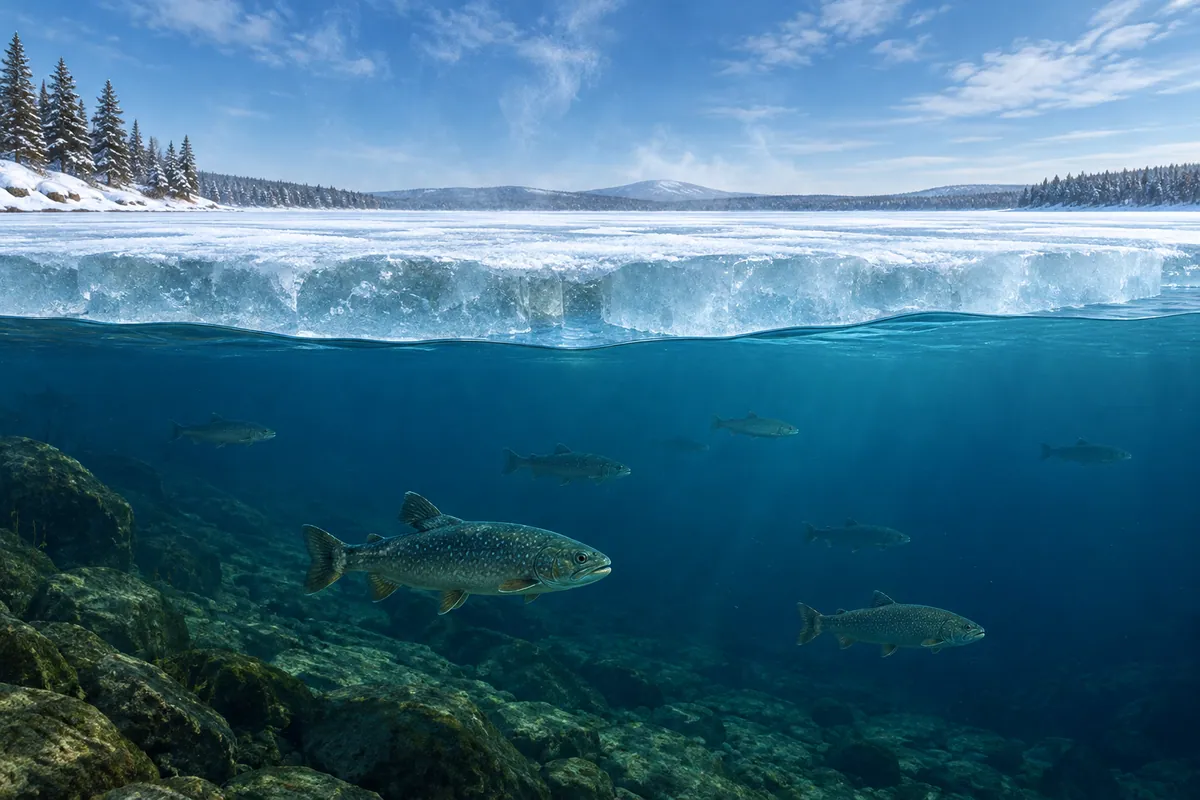
Ice floats because it is less dense than water, so it remains at the surface rather than sinking. This changes how lakes and ponds freeze. In cold weather, the surface loses heat first. Water cools and becomes denser until it reaches about 4 degrees Celsius, at which point it tends to sink and mix with the water below.
Once the surface water cools below about 4 degrees Celsius, it becomes less dense and remains nearer the top. If the air stays cold enough, that surface layer eventually freezes. The new ice forms a floating cover rather than dropping to the bottom.
The ice cover slows the transfer of heat from the liquid water below to the cold air above. It therefore acts as an insulating layer. The water underneath can remain liquid even while the surface is frozen, allowing aquatic ecosystems to persist through cold seasons.
This does not mean the water below is always warm. It means that the floating ice prevents the whole body of water from being exposed directly to the cold air, while the unusual density behaviour of water helps maintain layers at different temperatures. In a lake covered by ice, the densest water is near the bottom at around 4 degrees Celsius, with colder water above it.
Does all ice float in every kind of water?
Ordinary ice floats in ordinary liquid water, but floating always depends on the comparison between the object’s density and the surrounding fluid’s density. Salt water is denser than fresh water, which is why icebergs float in the ocean as well as ice cubes float in a glass of fresh water.
The amount of an iceberg visible above the ocean is only a small part of the whole. Most of its volume remains underwater because the difference between the density of ice and the density of seawater is not enormous. The denser the surrounding liquid, the less of a floating object needs to be submerged to support its weight.
There are also unusual forms of water. Heavy water contains deuterium, a heavier form of hydrogen. Ice made from heavy water can be denser than ordinary liquid water and can sink in it. This does not contradict the usual rule; it demonstrates it. Whether something floats depends on its density relative to the particular fluid around it.
The same principle explains why an ice cube may behave differently in a drink containing dissolved substances. Sugar, salt and other dissolved materials can change the liquid’s density. The cube is still ordinary ice, but the surrounding fluid may be denser or less dense than fresh water.
Why this small oddity matters
Ice floating may seem like a minor curiosity, but it has large consequences for the natural world. If ice were denser than liquid water, newly formed ice on a lake would sink. More water would then be exposed at the surface, freeze and sink again. In a sufficiently cold climate, this process could allow bodies of water to freeze from the bottom upwards.
Because ordinary ice floats, freezing usually begins at the surface and produces an insulating layer. That does not make every lake safe from freezing, and it does not prevent severe cold from affecting aquatic life. It does, however, preserve a liquid environment beneath the ice in many places.
The property also affects landscapes and built environments. Expanding water can crack rocks, damage roads and burst pipes. In nature, repeated freezing and thawing helps break solid rock into smaller pieces. In engineering, the risk is managed through drainage, flexible materials, insulation and antifreeze mixtures.
So the answer to the everyday question is simple—ice floats because it is less dense than water—but the reason is unusually deep. A small, bent molecule forms temporary bonds in liquid form and a more open network in solid form. That molecular geometry turns freezing into expansion, expansion into lower density, and lower density into floating ice.
What to remember
- Ice floats because its density is lower than that of liquid water.
- Freezing locks water molecules into an open hydrogen-bonded crystal structure.
- Water is most dense at about 4 degrees Celsius, not at its freezing point.
- Floating ice forms an insulating surface layer that helps liquid water remain beneath it.
- Floating always depends on the density of both the object and the surrounding fluid.
Sources & further reading
Where this story comes from
- Properties of waterU.S. Geological Survey
- 2.2 WaterOpenStax
- 14.4 Archimedes’ Principle and BuoyancyOpenStax
- 3.11: Hydrogen BondsChemistry LibreTexts
- IceNational Geographic Education
- The Earth’s Dynamic Cryosphere and the Earth SystemU.S. Geological Survey
- Heavy IceU.S. Geological Survey
This story was researched, drafted and illustrated with AI, then automatically checked against ANTB's structural and sourcing rules. Use the linked primary and institutional sources to verify important details.
 How things work · 5 min read
 How things work · 6 min read
 How things work · 6 min read