
In this story
An onion is built like a chemical storage system
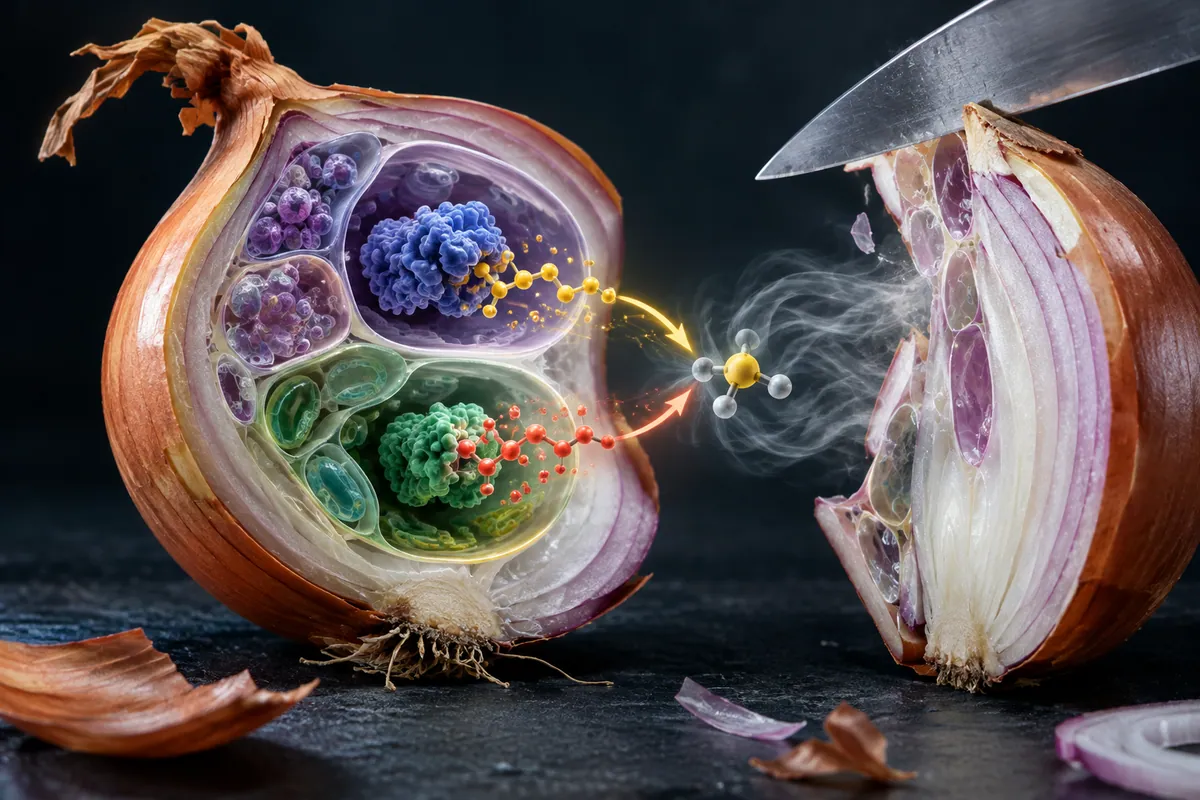
An intact onion does not normally make your eyes sting. Much of the chemistry is kept under control because its ingredients are stored in different parts of the plant cells. The onion contains sulphur-containing amino-acid sulfoxides, including the precursor associated with its pungent flavour. Enzymes that can react with these compounds are held separately inside the cell.
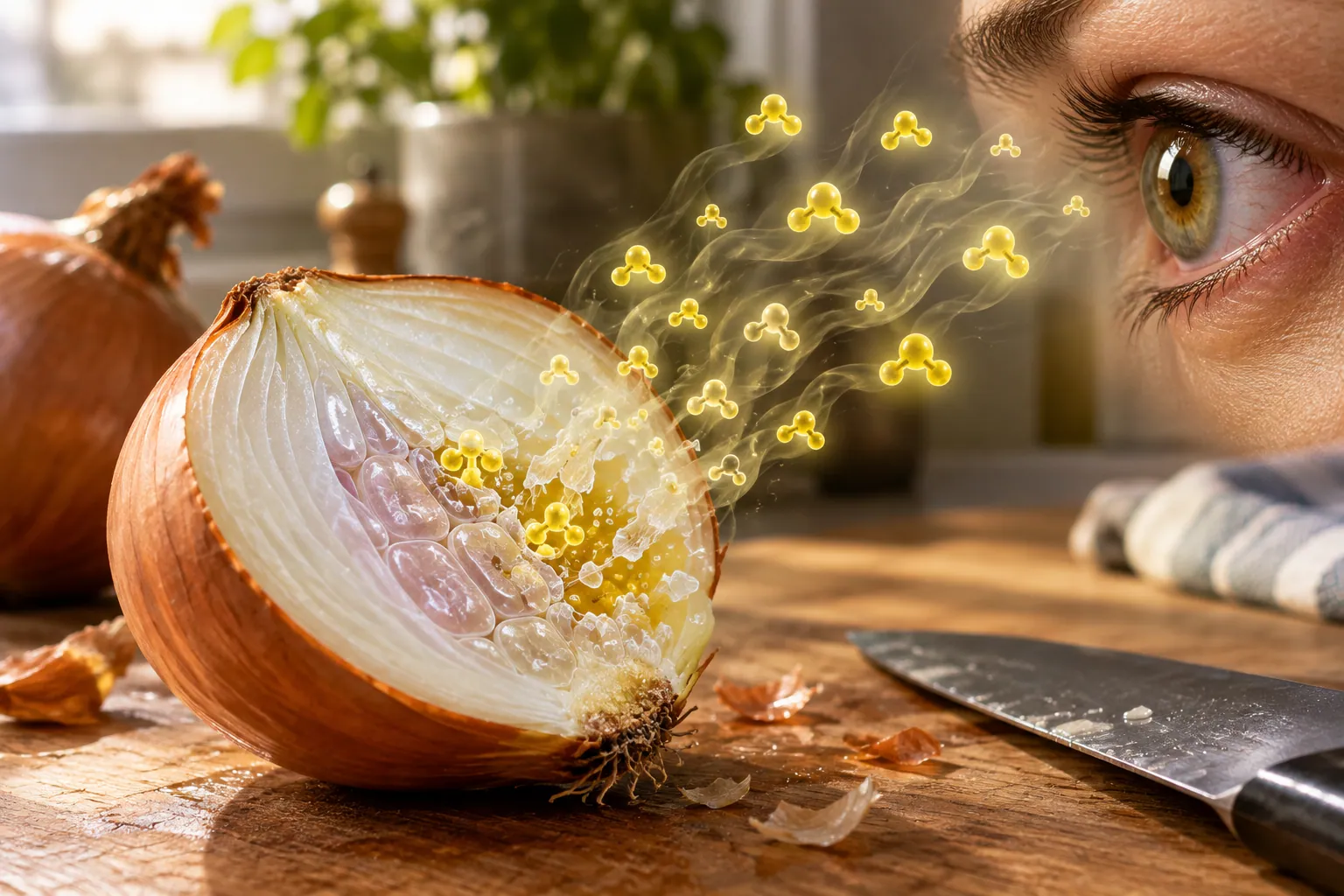
That arrangement changes the moment a knife cuts through the onion. Cutting ruptures cell walls and membranes, allowing the stored compounds and enzymes to mix. The onion’s flavour, smell and tear-producing effect are all consequences of this sudden chemical disruption.
This is part of the plant’s defence system. The reactions produce compounds that are unpleasant to many animals and can also contribute to the onion’s characteristic flavour. In other words, the tears are not an accidental side effect of chopping; they are the result of a defensive chemical pathway that becomes active when the tissue is damaged.
What happens after the cells are damaged?
The first important enzyme is alliinase. When the onion’s precursor compounds meet alliinase, the enzyme helps break them down and produces sulfenic acids, including 1-propenesulfenic acid. These intermediate compounds are chemically unstable and can quickly undergo further reactions.
A second enzyme, called lachrymatory-factor synthase, changes one of these intermediates into syn-propanethial-S-oxide. The name is formidable, but the important point is simple: this is a small, volatile sulphur compound that can leave the cut onion and travel through the air.
Earlier explanations treated the tear-producing compound as something that formed automatically as a by-product of the alliinase reaction. Research published in Nature showed that this was incomplete. The onion uses a specific enzyme, lachrymatory-factor synthase, to make the lachrymatory factor. Later structural work examined how that enzyme performs the conversion.
The compound is commonly described as the onion’s lachrymatory factor because ‘lachrymatory’ means tear-producing. Chemical studies have identified the principal form as syn-propanethial-S-oxide, with related forms and breakdown products also detectable among the volatile substances released by freshly cut onion tissue.
Why do the eyes respond with tears?
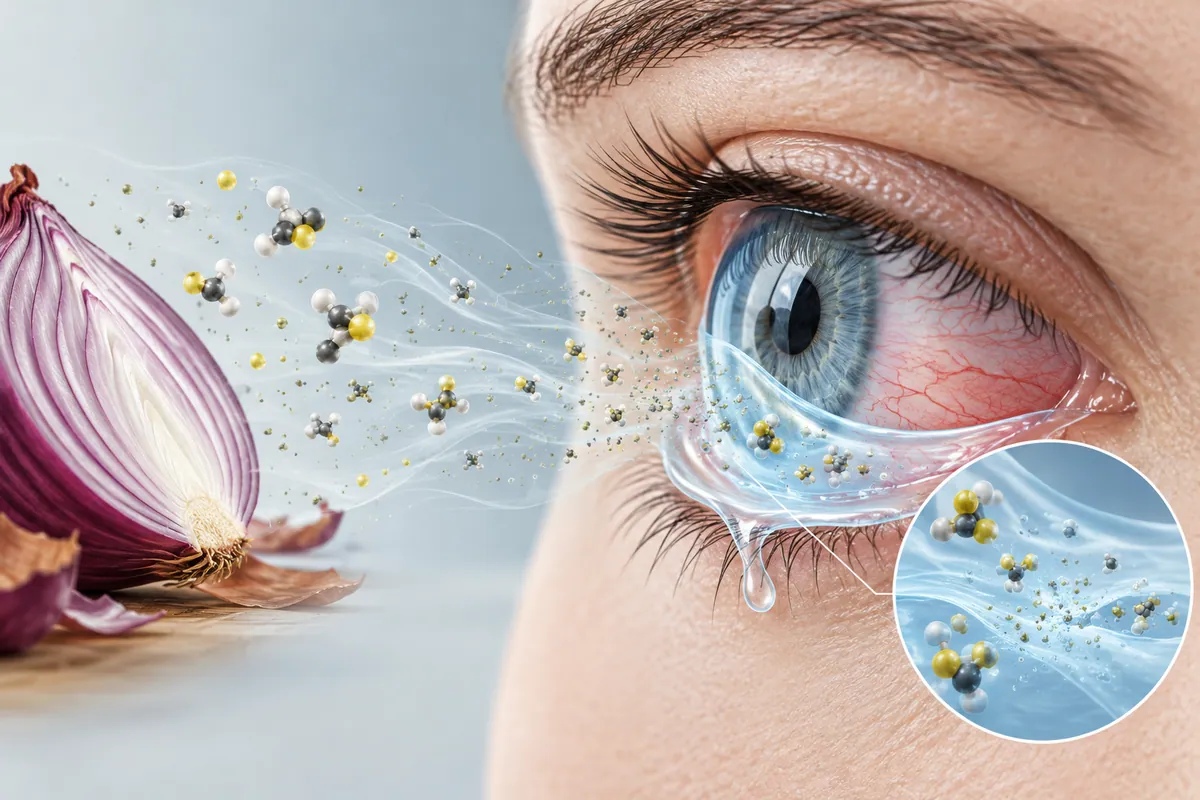
The lachrymatory factor is volatile, so it moves from the cut surface into the air around the onion. When it reaches the eye, it dissolves in the thin watery layer covering the eye’s surface. There it acts as an irritant, stimulating sensory nerves associated with burning or discomfort.
Those nerve signals activate the lacrimal glands, which produce tears. The tears spread across the eye and help dilute and remove the irritating compound. Blinking then distributes the fluid over the surface and carries some of it towards the inner corner of the eye, where it can drain through the tear ducts.
This is why the response can feel disproportionate to the tiny amount of onion involved. The eye is a sensitive exposed surface, and the tear response is designed to react quickly to airborne irritants. The onion does not need to damage the eye for the reaction to begin; irritation alone is enough to trigger watering.
The tears produced while chopping are therefore reflex tears rather than the kind associated with sadness. Their immediate purpose is physical protection: dilute the irritant, flush it away and keep the eye’s surface comfortable.
Why do some onions make you cry more than others?
Different onion varieties can contain different amounts of the precursor compounds and can produce different quantities of pungent and lachrymatory substances. Growing conditions, cultivar and maturity can all affect the chemistry of the bulb, so two onions may not produce exactly the same eye-watering effect.
Researchers have measured the lachrymatory factor and related flavour compounds in onion varieties, and studies of onion breeding have explored whether it is possible to reduce tear production while retaining desirable flavour. A ‘tearless’ onion can be produced by reducing the activity or expression of the enzyme responsible for making the lachrymatory factor.
There is a trade-off in this chemistry. The same general reaction network contributes to the flavour and aroma people associate with fresh onion. Reducing the tear-producing pathway may alter the balance of other compounds as well, which is why a less irritating onion is not simply an ordinary onion with one ingredient removed.
The amount of irritant that reaches your eyes also depends on how the onion is cut, how quickly it is cut and how close your face is to the board. These factors affect how much damaged tissue is exposed and how readily volatile compounds reach the eyes, although the underlying biochemical pathway remains the same.
Do common kitchen tricks work?
Many onion-cutting tips aim to reduce either the production of the irritant or the amount that reaches the eyes. Chilling an onion can slow chemical reactions before cutting, and using a sharp knife can reduce crushing of the tissue. Keeping the cut surface away from your face and increasing ventilation can also reduce the concentration of volatile compounds around your eyes.
The chemistry suggests why these methods may help, but they do not switch off the onion’s defence system completely. Once cells are damaged, the relevant enzymes and precursors can still react. The exact benefit of any technique depends on the onion, the temperature, the knife and the airflow in the kitchen.
The central lesson is that the onion is not releasing a pre-existing reservoir of ‘onion tears’. It is manufacturing the irritant at the moment its cells are broken. That is why cutting, grating or crushing an onion can be much more eye-watering than handling it whole.
A small plant defence with a precise chemical trigger
The familiar experience of watery eyes is an elegant example of plant chemistry. A physical event — a knife cutting through tissue — starts a sequence involving stored precursors, enzymes, an airborne molecule and a rapid response from the human eye.
The final irritant, syn-propanethial-S-oxide, is unusual in nature, but its effect is easy to observe. It is volatile enough to travel, reactive enough to irritate the eye and short-lived enough to break down after release. The onion’s chemistry turns a damaged bulb into a brief cloud of defence compounds.
So the next time an onion makes you cry, the explanation is not that the vegetable is somehow ‘sad’. It is that cutting has opened a biochemical assembly line, and your eyes are doing exactly what they evolved to do when an airborne irritant arrives.
What to remember
- Cutting ruptures onion cells and mixes enzymes with sulphur-containing precursors.
- Alliinase and lachrymatory-factor synthase help produce syn-propanethial-S-oxide.
- The volatile compound reaches the eye and triggers protective reflex tears.
- Different onion varieties can produce different amounts of tear-producing compounds.
- Chilling, ventilation and less tissue crushing may reduce exposure, but cannot eliminate the reaction entirely.
Sources & further reading
Where this story comes from
- syn-Propanethial S-oxideAmerican Chemical Society
- An onion enzyme that makes the eyes waterNature
- Enzyme That Makes You Cry—Crystal Structure of Lachrymatory Factor Synthase from Allium cepaACS Chemical Biology via PubMed Central
- Investigation of Volatiles Emitted from Freshly Cut OnionsPubMed Central
- Production and characterization of tearless and non-pungent onionScientific Reports
This story was researched, drafted and illustrated with AI, then automatically checked against ANTB's structural and sourcing rules. Use the linked primary and institutional sources to verify important details.
 How things work · 5 min read
 How things work · 6 min read
 How things work · 6 min read