
In this story
It is not making heat or cold
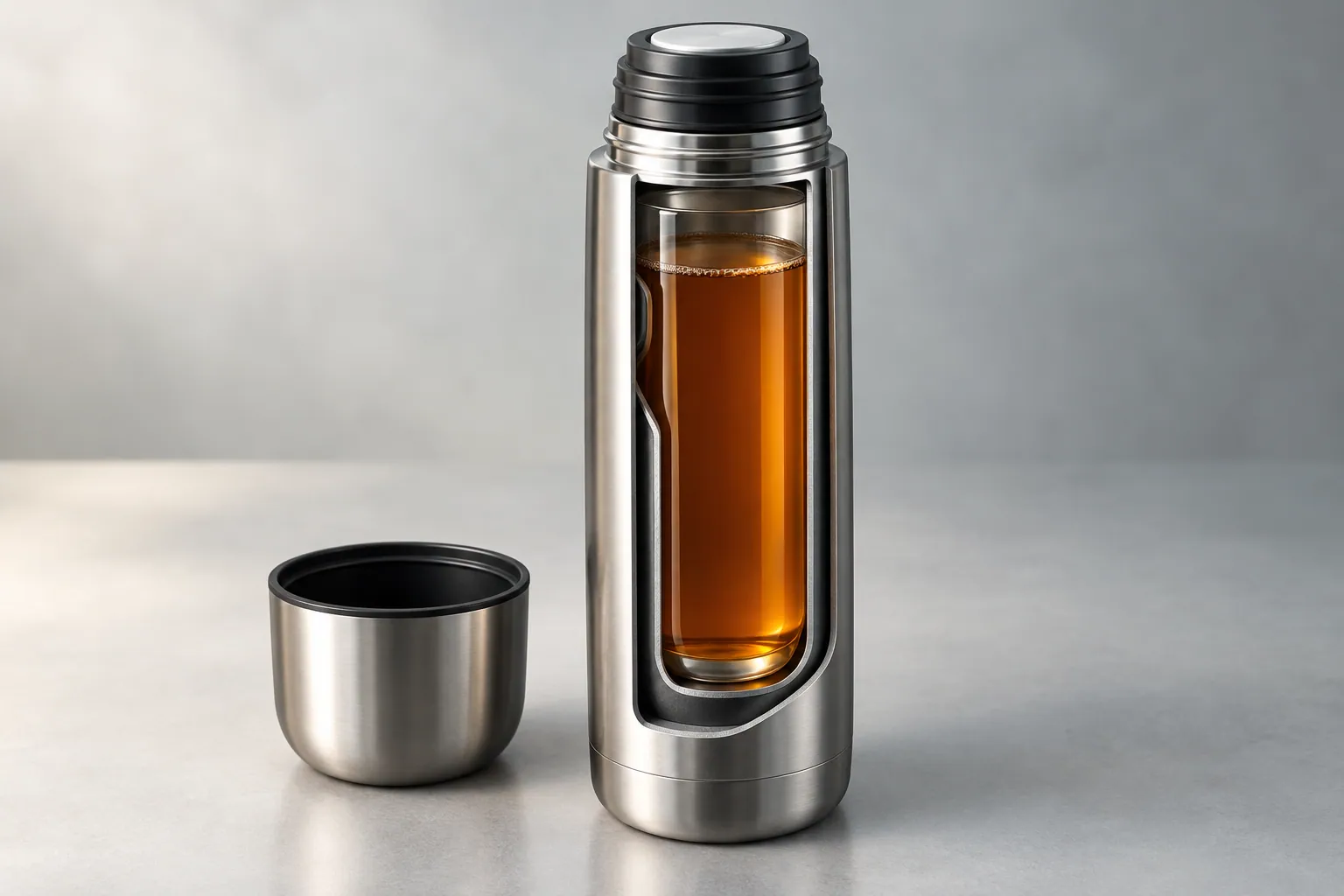
A thermos, also called a vacuum flask or Dewar flask, does not actively heat a drink or refrigerate it. It simply slows the exchange of thermal energy between the liquid and the surroundings. A hot drink still contains more thermal energy than the room around it, so heat naturally tends to leave it. A cold drink still contains less thermal energy than the surrounding air, so heat tends to enter it.
The flask works by making that exchange unusually difficult. In everyday life, thermal energy travels mainly by conduction, convection and radiation. Conduction moves energy through a material by direct contact. Convection carries energy in moving liquids or gases. Radiation transfers energy as electromagnetic waves, including infrared radiation. A good thermos is designed to interfere with all three routes.
The double wall creates a vacuum
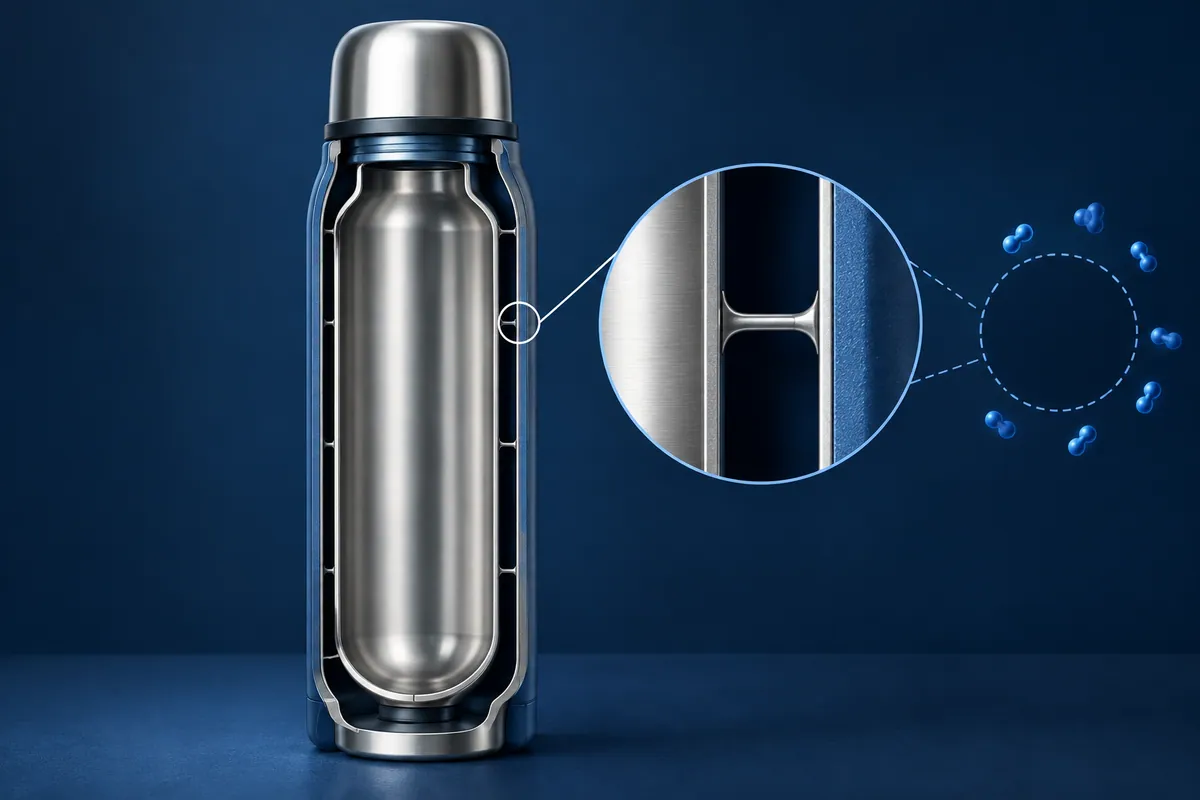
The most recognisable feature of a traditional thermos is its two walls: an inner vessel that holds the drink and an outer shell that you can touch. The space between them is evacuated, meaning that most of the air has been removed. With very little gas in that gap, there is much less material available to conduct heat from one wall to the other.
The vacuum also suppresses convection. Convection requires a moving fluid, such as air or water, to carry heat from one place to another. In an ordinary single-walled bottle, air near a hot surface warms, rises and is replaced by cooler air. That circulation helps transport heat. In the evacuated space of a vacuum flask, there is not enough air for this process to operate normally.
The vacuum is not perfect, and heat can still cross the flask through the solid supports, seals and neck that hold the inner vessel in place. These parts are necessary because the inner container cannot simply float unsupported inside the outer shell. They are therefore made or arranged to provide as little direct thermal connection as practical.
The shiny surface deals with radiation
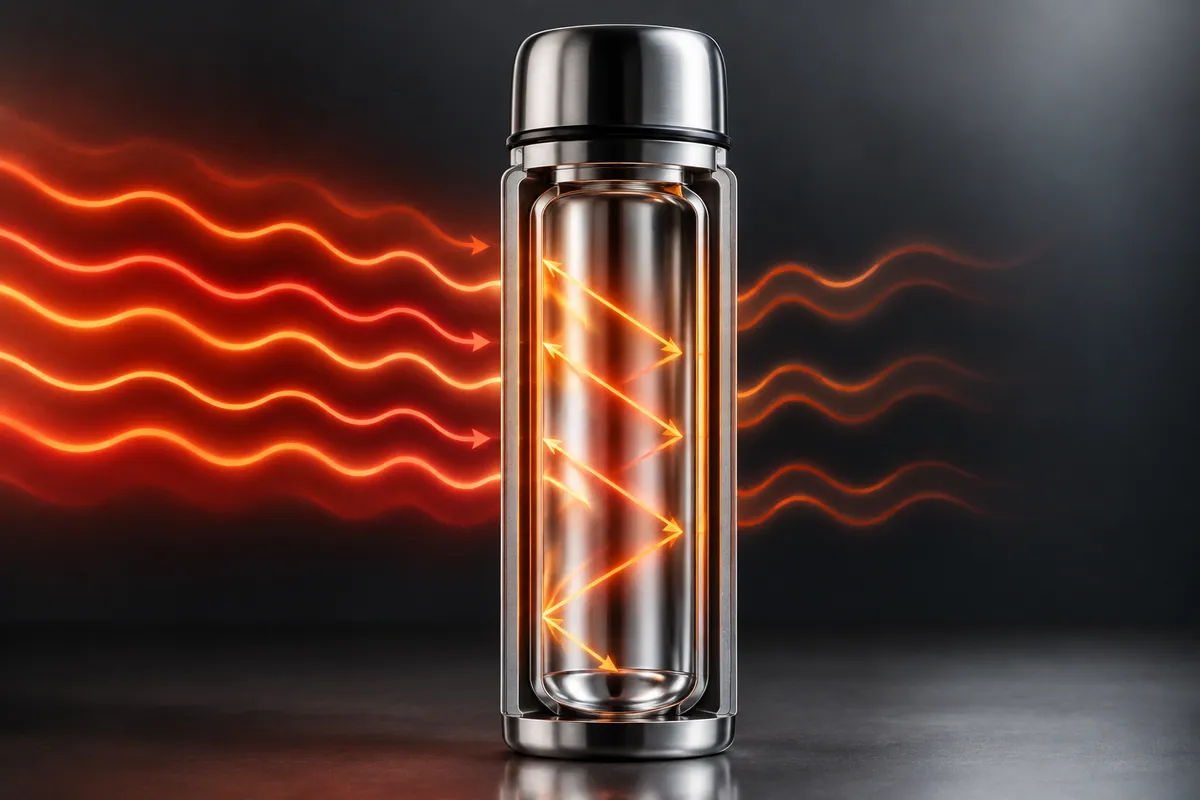
Removing air does not stop every form of heat transfer. Thermal radiation can cross empty space. A warm object emits infrared radiation, and a cooler object can absorb it. This is why you can feel warmth from sunlight or from a fire even though the air between you and the source is not carrying all of that energy.
For this reason, the surfaces facing the vacuum are often made shiny or given a reflective coating. Reflective surfaces emit and absorb less thermal radiation than dull, dark surfaces under comparable conditions. In a hot flask, the inner reflective surface sends more of the outgoing infrared energy back towards the drink. In a cold flask, it reduces the amount of radiant energy entering from the warmer surroundings.
This is why the familiar silvered appearance of older vacuum flasks was more than a decorative choice. The reflective layer was part of the thermal design. Modern flasks may use stainless steel and polished or specially treated surfaces rather than visibly silvered glass, but the principle remains the same.
The lid is an important weak point
The vacuum may surround most of the body, but the top of the flask cannot be left open. The opening must be sealed with a stopper, cap or lid, and that creates a direct route for heat to travel. A lid also has to accommodate practical features such as a drinking opening, thread, seal or pouring mechanism.
That is why the neck is usually narrow and the stopper is made from a material that conducts heat relatively poorly. Reducing the exposed opening reduces the area through which thermal energy can pass. Keeping the lid closed also prevents warm or cold air from moving freely in and out of the container. Every time the lid is removed, some of the air inside the flask is replaced, and the drink gains another opportunity to exchange heat with the room.
The lid is often the part of a flask that feels warmest or coldest. This does not mean the vacuum has failed. It reflects the fact that the lid and neck provide a more direct solid path than the insulated double wall.
Why it works for both hot and cold drinks
The same design can preserve either direction of temperature difference. If boiling water is poured into the flask, the insulation slows the movement of energy outwards. If iced water is poured in, the insulation slows the movement of energy inwards. The flask is not choosing whether to keep something hot or cold; it is reducing the rate at which the contents approach the temperature of their surroundings.
The result is not permanent. No practical thermos completely stops heat transfer. Over time, the drink will move towards room temperature because small amounts of energy continue to pass through the stopper, supports, seals and the walls by radiation and solid conduction. The larger the temperature difference, the stronger the initial tendency for heat to flow, although the exact performance depends on the flask’s materials, construction, vacuum quality, lid design and how often it is opened.
A thermos therefore preserves temperature rather than creating it. It buys time by making the usual routes for heat flow narrow, indirect or inefficient.
From laboratory equipment to everyday object
The principle was developed for scientific work rather than for keeping coffee warm. Scottish chemist and physicist James Dewar used vacuum-jacketed vessels in cryogenic research, where preventing unwanted heat from reaching very cold substances was essential. Museum records identify Dewar vacuum vessels from the late nineteenth and early twentieth centuries, including designs with double walls and reflective inner surfaces.
The laboratory vessel later became the model for domestic vacuum flasks. The same basic idea is still used in more demanding equipment, including containers for cryogenic liquids and thermal systems in spacecraft. The temperatures and engineering details differ, but the underlying strategy is familiar: remove or reduce the routes by which thermal energy can travel, then reflect as much remaining radiation as possible.
The everyday flask is therefore a compact lesson in heat transfer. Its effectiveness comes not from one magical material, but from several modest design decisions working together: a vacuum to suppress air-based transfer, reflective surfaces to reduce radiation, slender supports to limit conduction, and a stopper to close the remaining opening.
What to remember
- A thermos slows heat transfer rather than producing heat or cold.
- The vacuum between its walls reduces conduction through air and prevents normal convection.
- Reflective inner surfaces reduce the exchange of infrared radiation.
- The lid, neck, seals and supports remain unavoidable paths for some heat flow.
- A vacuum flask eventually approaches room temperature because no practical insulation is perfect.
- The design originated in scientific vacuum vessels associated with James Dewar’s cryogenic research.
Sources & further reading
Where this story comes from
- Cosmicopia: Heat, Temperature and the Electromagnetic SpectrumNASA Goddard Space Flight Center
- Thermal ControlNASA SmallSat Institute
- Heat TransferNational Institute of Standards and Technology
- Vessels for the storage and transport of liquid hydrogenNational Bureau of Standards, now NIST
- James DewarScience Museum Group
- Dewar vacuum vesselScience Museum Group Collection
- James Dewar archival recordThe Royal Society
This story was researched, drafted and illustrated with AI, then automatically checked against ANTB's structural and sourcing rules. Use the linked primary and institutional sources to verify important details.
 How things work · 6 min read
 How things work · 5 min read
 How things work · 5 min read