
In this story
The oven creates an invisible electrical field
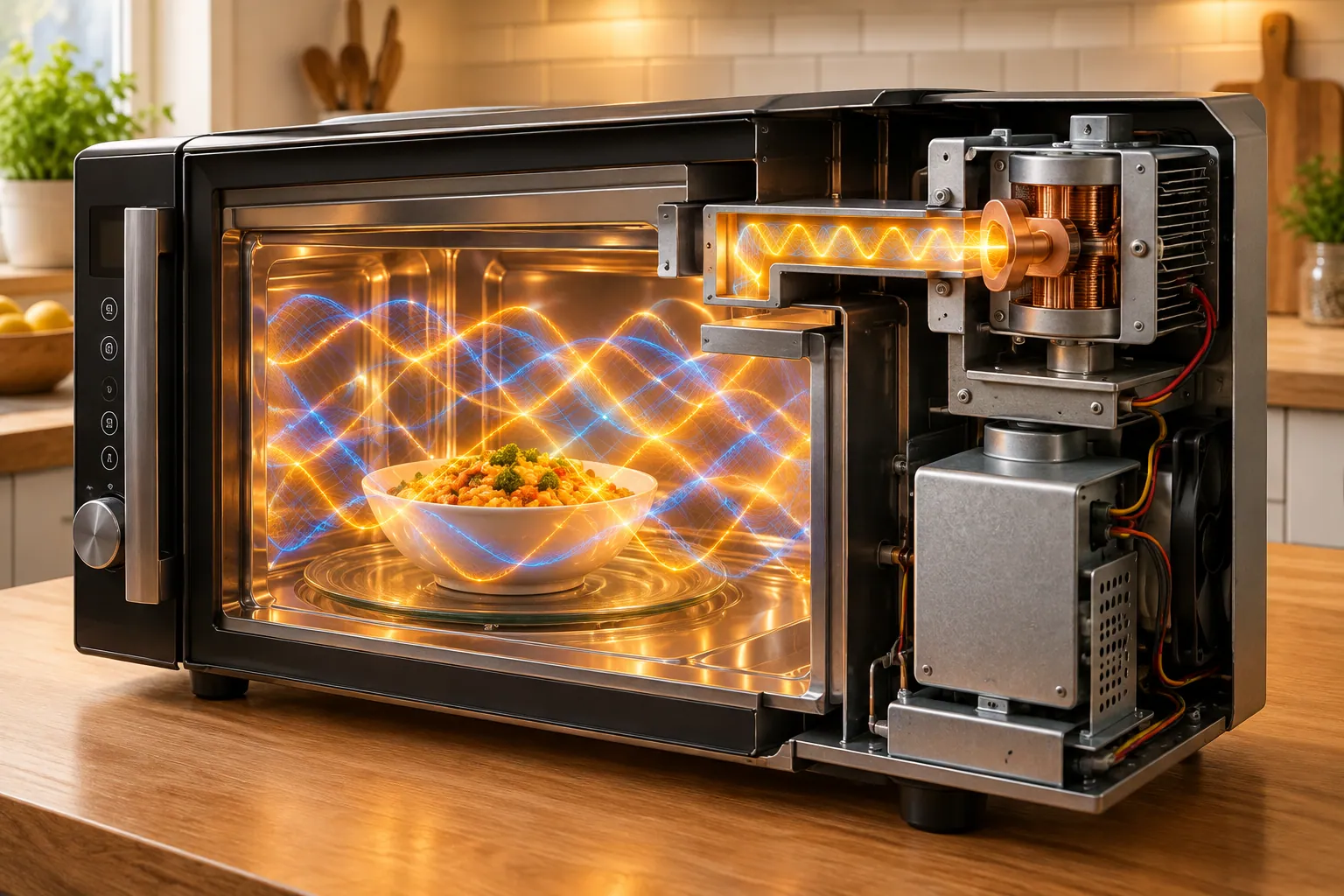
When you press Start, electricity is converted into the high voltage needed by a component called a magnetron. The magnetron is an electron tube that generates microwave energy. A metal channel called a waveguide directs that energy into the cooking cavity. Domestic microwave ovens commonly operate at about 2.45 gigahertz, a frequency chosen for practical heating and permitted use in industrial, scientific and medical applications.
Microwaves are a form of electromagnetic radiation, like radio waves, infrared radiation and visible light. They are non-ionising, which means they do not carry enough energy per photon to knock electrons out of atoms in the way X-rays can. Their important property in an oven is not that they are unusually energetic, but that their changing electric field can transfer energy to materials that absorb it.
Why water helps food heat up
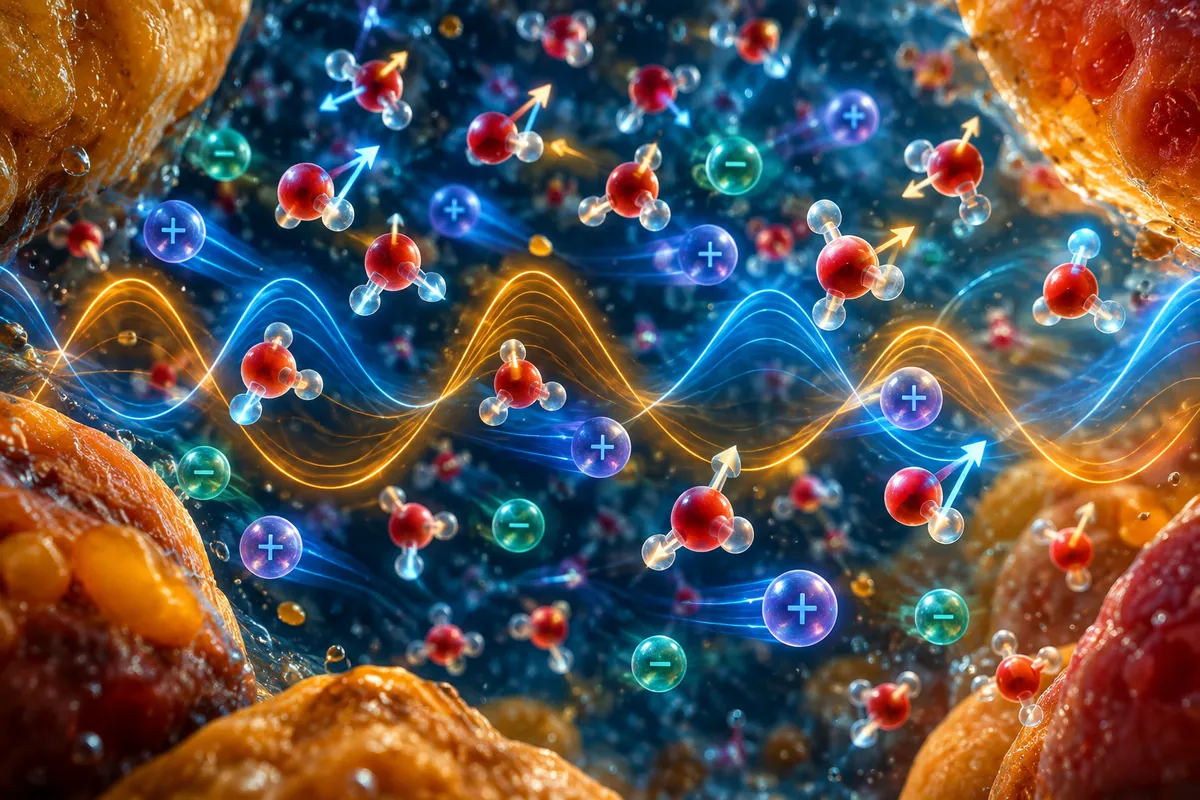
Water molecules are polar: their electrical charge is distributed unevenly, leaving one end slightly more positive and the other slightly more negative. In a microwave oven, the electric field changes direction billions of times per second. Polar molecules try to turn and follow that changing field, while neighbouring molecules and hydrogen bonds resist their movement. The lag and molecular motion convert some of the microwave energy into thermal energy.
Food is not made only of water. Fats, sugars, dissolved salts and other substances can also absorb microwave energy, although they do so at different rates. Charged ions in food contribute to heating as they move through the alternating field. This is why a food’s composition, moisture content and physical structure affect how quickly it warms.
The popular explanation that microwaves work because they make water molecules resonate is misleading. Household ovens use an alternating field that causes energy absorption in the food, but the process is not simply a precise tuning fork effect in which every water molecule vibrates at one special resonant frequency. The detailed behaviour depends on the material, its temperature, its water content and the way the field is distributed.
Why the bowl may stay cool
Microwave energy passes relatively easily through materials such as glass, paper, ceramic and some plastics. These materials generally absorb less energy at microwave frequencies than food does, so the container may initially remain much cooler than its contents.
That does not mean a microwave-safe container can never become hot. Heat from the food can conduct into the bowl, plate or lid. A container may therefore be hot after cooking even when it has absorbed little microwave energy itself. Some plastics can soften or melt because of heat transferred from the food, which is why manufacturers specify which containers are suitable for microwave use.
Metal behaves differently. It reflects microwaves rather than allowing them to pass through in the same way. Smooth, appropriately designed metal components can form part of the oven’s structure, but loose metal objects, foil edges or unsuitable containers can produce uneven heating, sparks or possible damage. The correct choice depends on the oven and the manufacturer’s instructions.
Why food heats unevenly
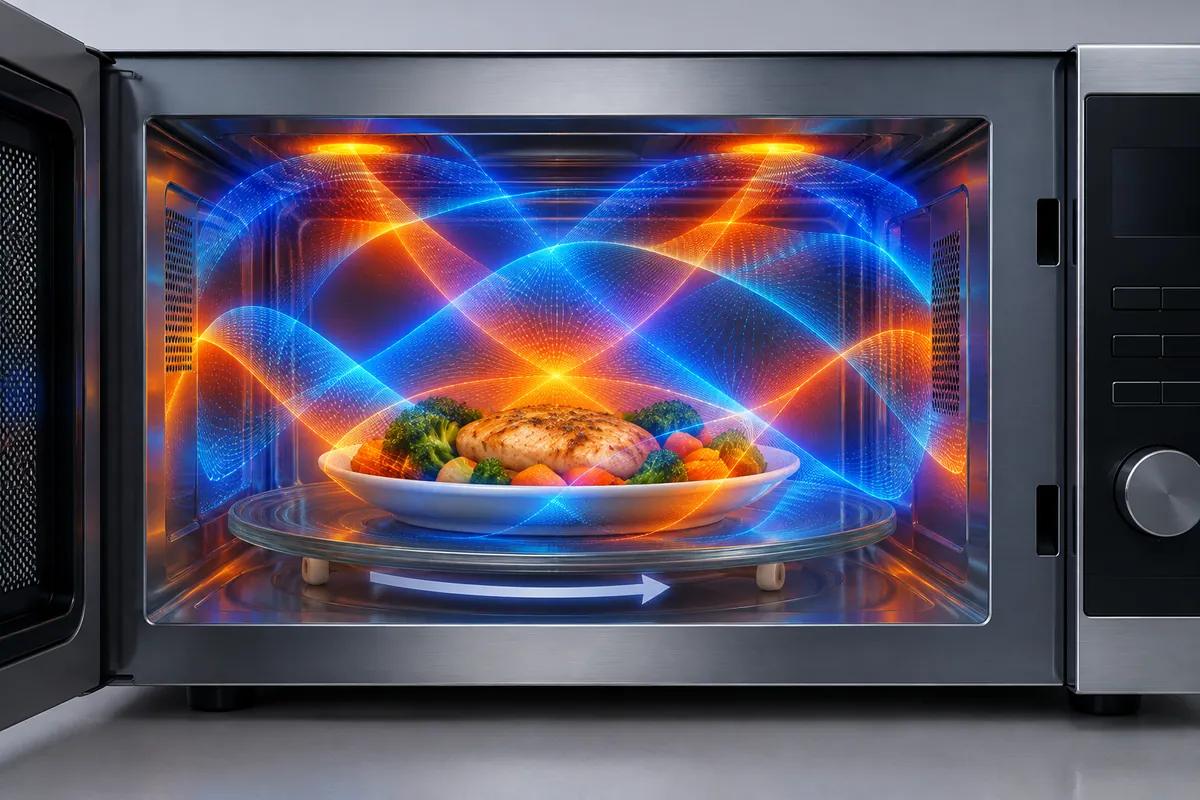
The microwaves reflect from the oven’s metal walls and combine with one another. This creates a changing pattern of stronger and weaker electric fields inside the cavity. A fixed item of food could therefore have warmer and cooler regions, depending on where it sits.
Many ovens use a rotating glass turntable to move the food through these regions. Some designs also use a rotating metal component in the waveguide to alter the microwave pattern. These methods do not make the field perfectly uniform, but they spread the energy more evenly over time.
Food shape matters as well. Thin areas can heat quickly, while thick or irregular sections may remain cooler. Stirring, turning, covering and allowing food to stand after heating all help redistribute temperature. Manufacturers’ instructions often recommend these steps because the microwave field does not guarantee that every part of a meal reaches the same temperature at the same moment.
It does not really cook from the inside out
Microwaves can deposit energy below the surface of food, which is different from a conventional oven that mainly heats the surface first. But a microwave oven does not simply cook from the inside out.
Microwave energy becomes weaker as it travels through food, and the depth it reaches depends on the food’s composition, temperature and structure. In a thick item, the outer regions may absorb a substantial share of the energy. Heat then moves inward from hotter areas by ordinary conduction. This is one reason a thick dish can be hot at the edges but cool in the centre, and why standing time is useful.
The oven is therefore doing two things at once: microwave absorption produces heat within parts of the food, and conduction spreads that heat through the rest. The balance between those processes changes with the food being heated. A watery soup, a dense potato and a frozen meal do not respond in exactly the same way.
Why the oven itself does not fill with microwaves
The cooking cavity is enclosed by metal, which reflects microwave energy back towards the food. The door also contains a conductive metal screen that helps keep the microwave field inside while allowing visible light through so the user can see the food.
Safety systems are just as important as the enclosure. Modern ovens are designed with independent door interlocks that stop microwave generation when the latch is released or the door is opened. Regulatory standards also limit the amount of microwave energy that may leak from an oven during its lifetime.
A microwave oven should not be used if its door, hinges, latch or seals are damaged, or if it continues operating with the door open. Most everyday injuries connected with microwave ovens are ordinary heat injuries from hot food, containers or liquids rather than exposure to microwave radiation.
What to remember
- A magnetron generates microwave energy and a waveguide directs it into the cooking cavity.
- The alternating electric field makes polar molecules and charged particles move, converting electromagnetic energy into heat.
- Food, not the surrounding air, is the main thing being heated directly.
- Metal reflects microwaves, while many glass, ceramic, paper and plastic containers allow them to pass through.
- Turntables, rotating field stirrers, stirring and standing time help reduce uneven heating.
- Microwave ovens do not cook purely from the inside out; heat is also redistributed through the food by conduction.
Sources & further reading
Where this story comes from
- Microwave OvensU.S. Food and Drug Administration
- Improving Process Heating System Performance: A Sourcebook for Industry, Third EditionU.S. Department of Energy
- Microwave Oven Standby Mode and Off Mode: Market and Technology AssessmentU.S. Department of Energy
- The Interaction of Radio-Frequency Fields With Dielectric Materials at Macroscopic to Mesoscopic ScalesNational Institute of Standards and Technology
This story was researched, drafted and illustrated with AI, then automatically checked against ANTB's structural and sourcing rules. Use the linked primary and institutional sources to verify important details.
 How things work · 6 min read
 How things work · 5 min read
 How things work · 5 min read