
In this story
The road inherited an older signalling problem
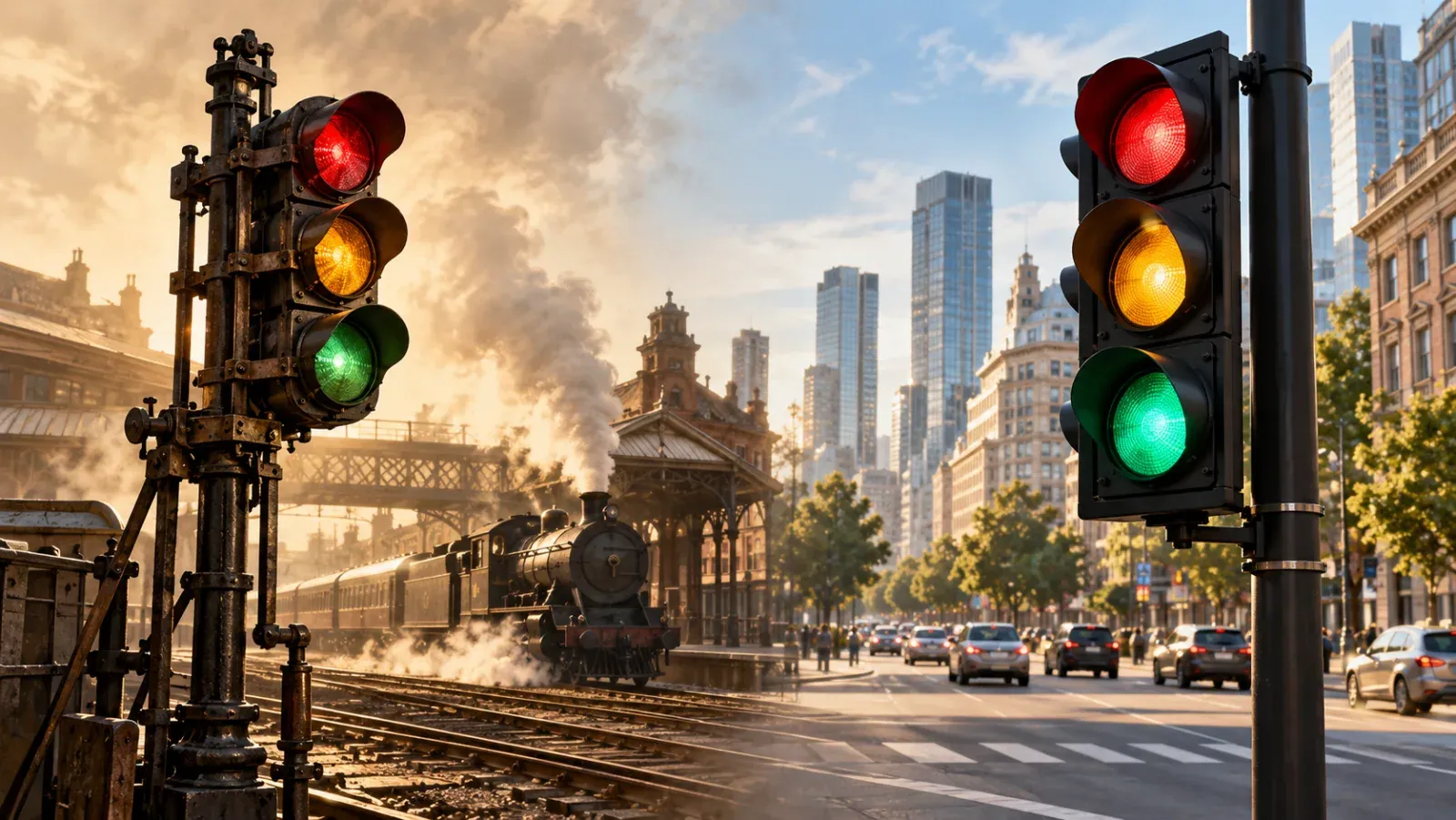
A traffic light solves a coordination problem: people approaching the same space cannot all move first. Railways faced a more severe version decades before busy motor intersections. A train could not turn aside quickly, and at night a driver needed an instruction that could be recognised at distance. Mechanical arms supplied shape by day; coloured glass in front of lamps carried the message after dark.
Objects preserved by the Smithsonian show railway equipment using red and green glass for night signalling. That does not mean every railway began with an identical colour code. Early systems varied, and museums preserve several arrangements. What matters is that transport operators had already learned to combine position, shape and colour into a compact safety language before cities began mechanising street control.
The first street signals were experiments
The Library of Congress traces the first traffic lights to London in 1868, near Westminster Bridge. The gas-lit apparatus had to be operated by a police officer and was abandoned after an explosion injured its operator. Electric road signals arrived much later. The Federal Highway Administration records the first electric traffic signal in the United States in Cleveland in 1914, as cities searched for ways to organise pedestrians, streetcars, bicycles and cars.
Those early devices did not instantly produce the familiar hanging stack. Some displayed words, some used two states, some were controlled manually and some sat in towers. Their diversity is useful evidence: the modern signal was assembled through iteration, not delivered as a finished invention by one person on one date.
Yellow created time between two conflicting commands
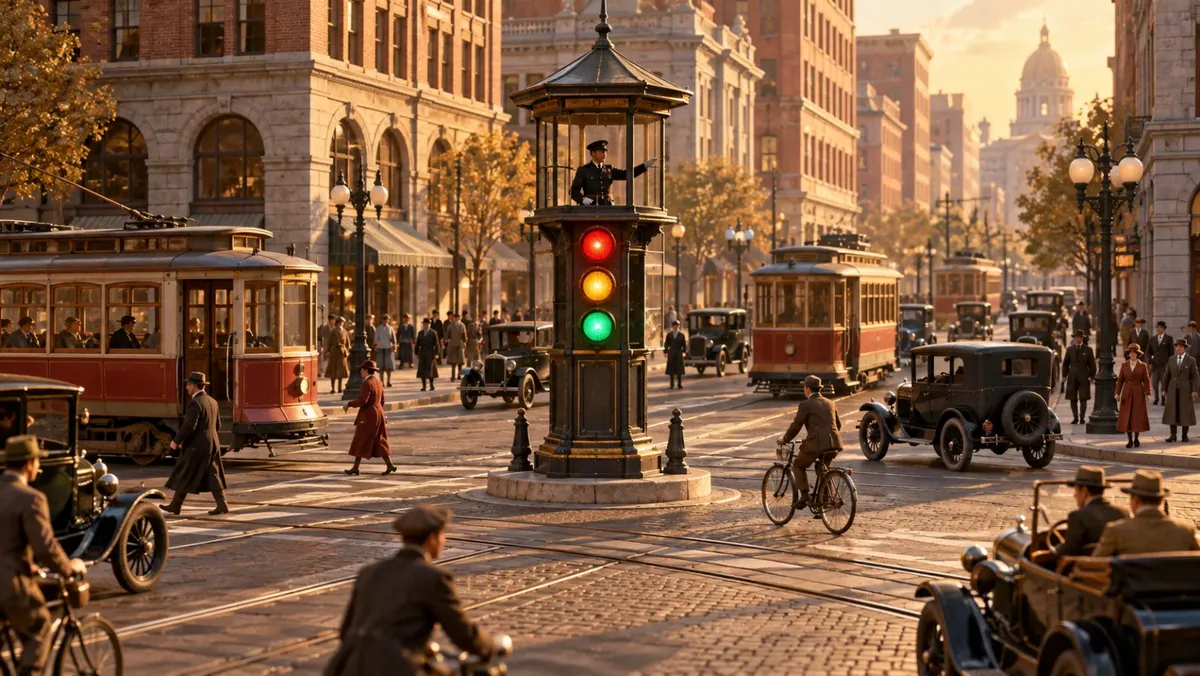
A two-state signal can create an abrupt handover. If one direction receives stop at the same instant another receives go, people already committed to the intersection need somewhere in the logic to clear it. The Library of Congress credits Detroit police officer William Potts with adding a yellow light in 1917 to warn that the indication was about to change. The FHWA timeline dates Detroit's first installed three-colour signal to 1920. Read together, the records show an idea developing into an operating system rather than a single ceremonial first.
Yellow is therefore not simply a weaker red. In modern signal timing, the FHWA describes the yellow change interval as a warning that right of way is ending. Its duration accounts for perception, reaction and the choice to stop or continue safely. Some systems add a red-clearance interval before a conflicting movement receives green.
Garrett Morgan improved the transition—but the story is often simplified
Garrett Morgan received a United States patent in 1923 for a three-position traffic signal. His third position stopped traffic in all directions before movement resumed on the crossing road. The FHWA explains that this reduced the dangerous jump between stop and go and offered pedestrians a safer opportunity to cross. Morgan's work belongs in the history of the system, but calling him the sole inventor of the modern red-yellow-green light erases earlier signals and confuses his all-stop position with the coloured yellow interval.
That distinction makes the history more interesting, not less. Potts, Morgan and other designers were responding to the same missing element: a controlled transition. Modern intersections still use both ideas—yellow change time and, where engineers judge it useful, a brief red-clearance period.
Standardisation made the colours feel inevitable
Local inventions only become a public language when their meanings stop changing from place to place. The FHWA's history of the Manual on Uniform Traffic Control Devices describes 1920s efforts to standardise colours and the adoption of the three-colour signal as a national standard in the first MUTCD in 1935. Red meant stop, green meant proceed and yellow marked caution or transition. Repetition across streets, cities and countries trained generations of road users to read the sequence almost automatically.
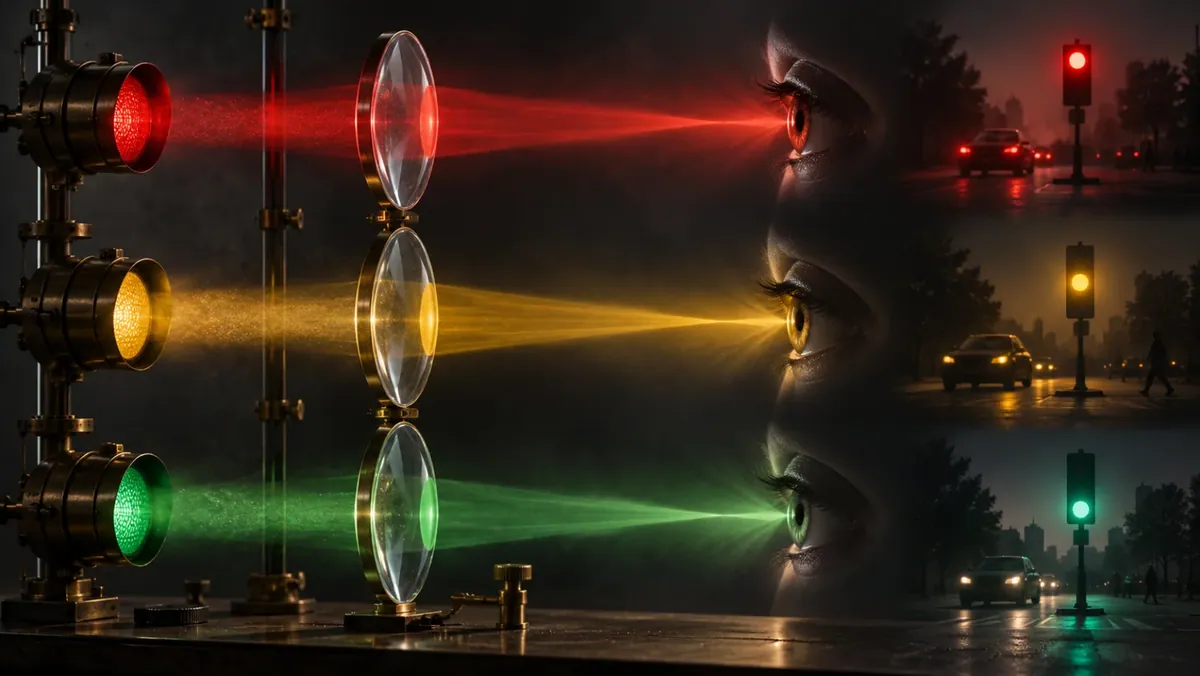
Colour is not the only cue, and it should not be. The fixed vertical order, separate lenses, arrows, audible pedestrian indications and timing patterns help people interpret a signal under glare, at distance or with colour-vision differences. The familiar palette succeeds because it is part of a redundant system: colour, position and sequence reinforce one another. What looks like three simple lamps is really a century of negotiated engineering.
What to remember
- Road traffic signals inherited ideas and equipment from railway signalling.
- Yellow was added to warn that right of way was about to change, reducing the abrupt jump between stop and go.
- Garrett Morgan's patented third position stopped every direction; it was an important transition idea, not simply the first modern yellow light.
- National standards turned many local experiments into one repeatable red-yellow-green language.
- Position and sequence remain essential because colour alone is not equally accessible to everyone.
Sources & further reading
Where this story comes from
- The Evolution of MUTCDFederal Highway Administration
- Taking On Traffic: A Closer Look at the SignalsLibrary of Congress
- Safer Stop and Go: Garrett Morgan's Traffic Signal LegacyFederal Highway Administration
- Traffic Signal Timing Manual: Change and clearance intervalsFederal Highway Administration
- Railroad track signalSmithsonian National Museum of American History
ANTB prepared this original explanation from the museum and government sources listed below. The accompanying visuals are conceptual AI-generated illustrations and are labelled as such.
 History · 5 min read
 History · 6 min read
 History · 6 min read