

In this story
A month began as a Moon-shaped idea
The word month is related to the Moon because one of the earliest practical ways to divide a year was by watching the Moon’s repeating phases. A complete cycle from one new moon to the next takes about 29.5 days. Twelve such cycles make roughly 354 days, which is close to—but shorter than—the time Earth takes to orbit the Sun.
That mismatch explains why calendars are harder to design than they first appear. The day follows Earth’s rotation, the month approximates the Moon’s cycle and the year follows Earth’s orbit around the Sun. None of these periods fits neatly into the others as a whole number. A calendar that follows only the Moon will gradually move through the seasons; one that follows the Sun must treat the month as a convenient division rather than a precise lunar cycle.
Why not 10 months, or 13?
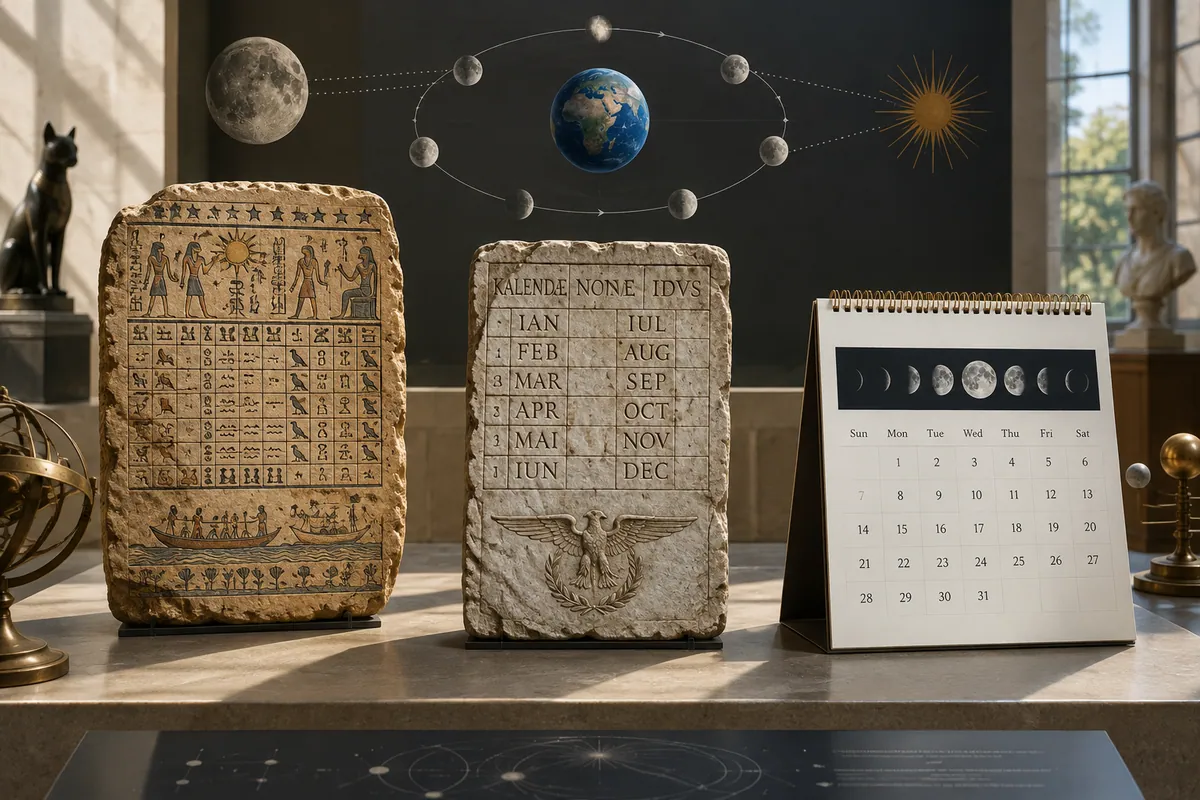
Twelve was not inevitable. Ancient societies used different systems, including lunar calendars with 12 months and calendars that inserted a 13th month when necessary. The ancient Egyptian civil calendar, for example, used 12 months of 30 days, followed by five additional days at the end of the year. It was simple and useful, but because it did not include a leap-year adjustment, its calendar dates gradually moved against the agricultural seasons.
The number 12 was attractive because it divided the year into manageable portions and was a reasonable approximation of the number of lunar cycles in a solar year. It also has many useful divisors: halves, thirds, quarters and sixths. That made a 12-part year convenient for organising religious observances, agricultural work, taxation and public administration. It was a practical convention, not a perfect measurement of nature.
The Roman calendar left clues in the month names
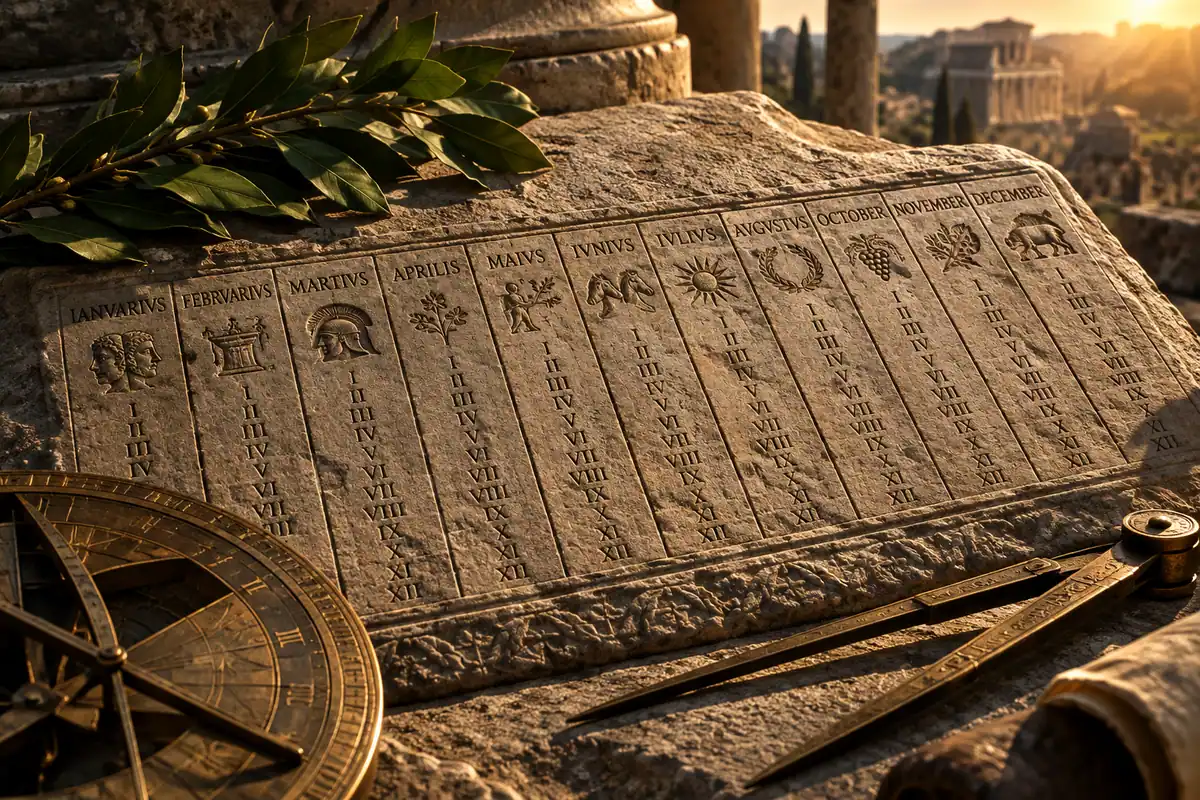
The calendar used across much of the world today inherited much of its structure from ancient Rome. According to the British Museum, the early Roman calendar began in March, while January and February were added later. This is why several month names seem to be shifted by two places: September means “seventh”, October “eighth”, November “ninth” and December “tenth”, even though they are now the ninth through twelfth months.
Roman tradition associated the addition and ordering of months with calendar reforms linked to Numa Pompilius, although the details of the earliest Roman calendar are uncertain. The surviving evidence shows that Roman calendars changed over time and could include an extra intercalary month to bring the civil year back into alignment with the seasons.
The Roman calendar was not just an astronomical tool. It also organised legal business, festivals, public duties and agricultural activity. The surviving Fasti Antiates, a Republican Roman calendar, records months, days, market cycles and the legal status of particular days. In other words, deciding how many months there were was also a way of organising society.
Why do the months have different lengths?
The unequal lengths of our months are another legacy of Roman calendar-making rather than a direct consequence of astronomy. In the calendar before Julius Caesar’s reform, months had varying lengths and the system could drift substantially away from the solar year. Caesar introduced a solar calendar in 46 BCE, with advice from the Alexandrian astronomer Sosigenes. The resulting Julian calendar used a year of about 365 days and added a leap day every four years.
That reform explains why our months are not all 30 days long. The Roman system already had established month names, festivals and administrative customs, so reformers adjusted the lengths rather than replacing the whole structure with 12 equal months. This is a recurring feature of calendars: once a system is embedded in law, religion and everyday life, convenience and continuity matter as much as astronomical neatness.
Why February is the odd one out
February is shorter because Roman calendar reforms used it as the month that absorbed the leftover adjustment. In the modern Gregorian calendar it has 28 days in an ordinary year and 29 in a leap year, while the other months have 30 or 31 days.
The need for a leap day comes from the fact that the tropical year is approximately 365.2422 days, not exactly 365. If every calendar year contained only 365 days, the calendar would fall behind the seasons by nearly a quarter of a day each year. The Julian rule of adding one day every four years was close, but slightly too long. Over centuries, that small error accumulated.
The Gregorian calendar, introduced in 1582, refined the rule. A year divisible by four is normally a leap year, except for century years that are not divisible by 400. That is why 2000 was a leap year, while 1900 was not. The rule makes the average Gregorian year 365.2425 days, a close approximation to the tropical year.
So is 12 the ‘correct’ number?
Not exactly. Twelve months is the convention used by the Gregorian calendar, the civil calendar now used in most countries, but other calendars organise the year differently. The Islamic calendar is purely lunar and its 12 months move through the seasons over a cycle of about 33 years. Luni-solar calendars use adjustments, such as an occasional extra month, to keep lunar months and solar seasons broadly connected.
Even within ancient Egypt, more than one way of tracking time could operate at once. The Met describes an Egyptian civil calendar of 12 months, while lunar observations and festivals could follow different cycles. This shows that calendars are not single discoveries handed down unchanged. They are layered systems built from observation, custom and the needs of institutions.
The best answer, then, is that there are 12 months because 12 is a useful approximation of the Moon’s cycles within the Sun’s year, and because Roman calendar reforms made that arrangement durable. Our calendar is neither purely lunar nor perfectly solar. It is a historical compromise that has proved convenient enough to survive for centuries.
What to remember
- Twelve months roughly matches the number of lunar cycles in a solar year, but 12 lunar months are about 11 days shorter than the solar year.
- The modern calendar inherited much of its month structure from Roman calendars, including the names and their uneven lengths.
- September, October, November and December preserve evidence that the Roman year once began in March.
- Leap years are needed because Earth’s seasonal year is about 365.2422 days, not exactly 365 days.
- Different cultures use different calendar systems, so 12 months is useful and historic rather than a universal rule of nature.
Sources & further reading
Where this story comes from
- Introduction to CalendarsUnited States Naval Observatory
- Leap YearsUnited States Naval Observatory
- What's in a name? Months of the yearThe British Museum
- Telling Time in Ancient EgyptThe Metropolitan Museum of Art
- The Roman CalendarEncyclopaedia Romana, University of Chicago
- Fasti AntiatesEncyclopaedia Romana, University of Chicago
This story was researched, drafted and illustrated with AI, then automatically checked against ANTB's structural and sourcing rules. Use the linked primary and institutional sources to verify important details.
 History · 5 min read
 History · 6 min read
 History · 6 min read