
In this story
Start with the shadow, not the clock
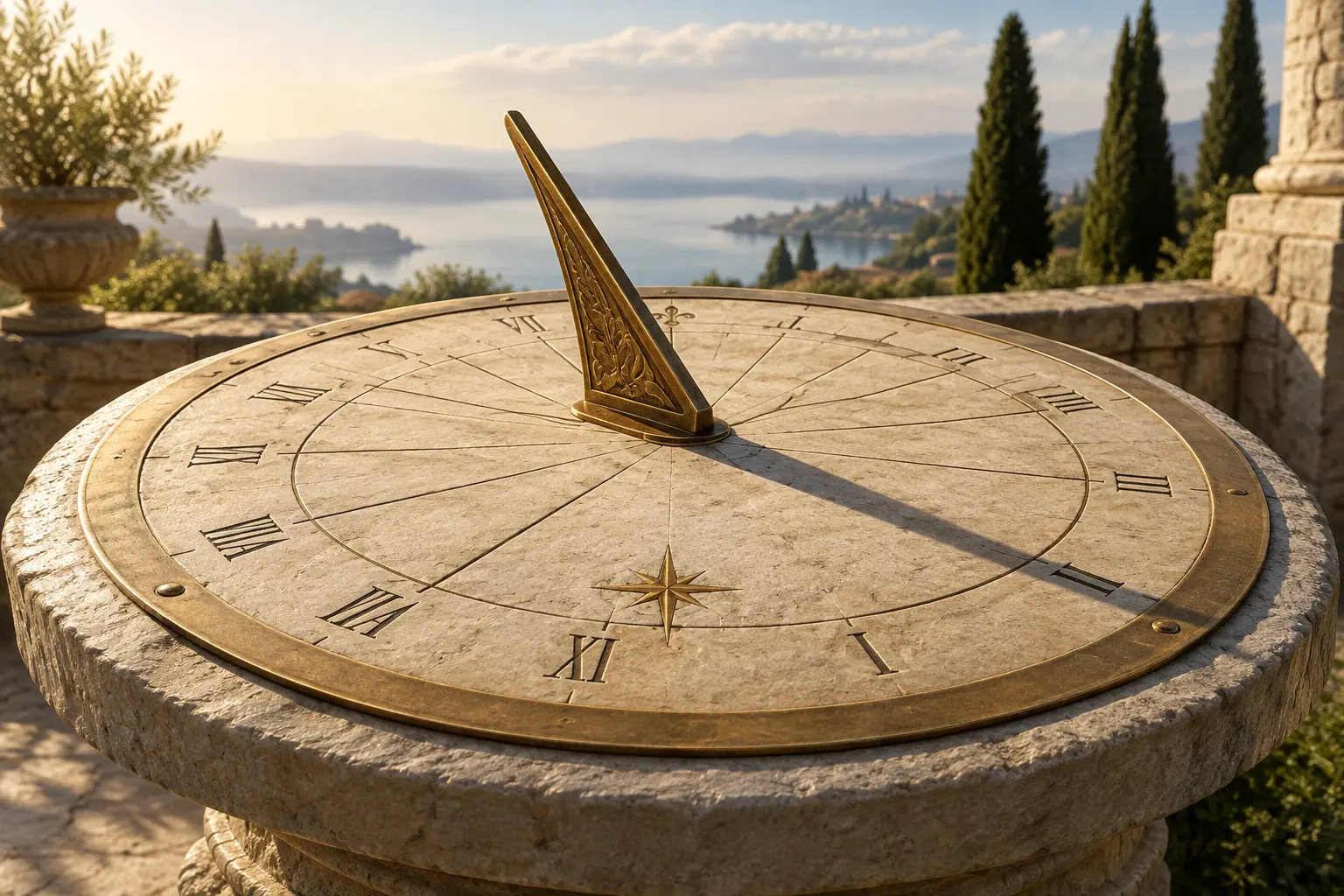
Before mechanical clocks became common, one of the simplest ways to follow the passage of the day was to watch a shadow. Put a stick or upright marker, called a gnomon, in sunlight and the shadow changes position as the Sun appears to travel across the sky. Mark the shadow’s position at known times and the arrangement becomes a sundial.
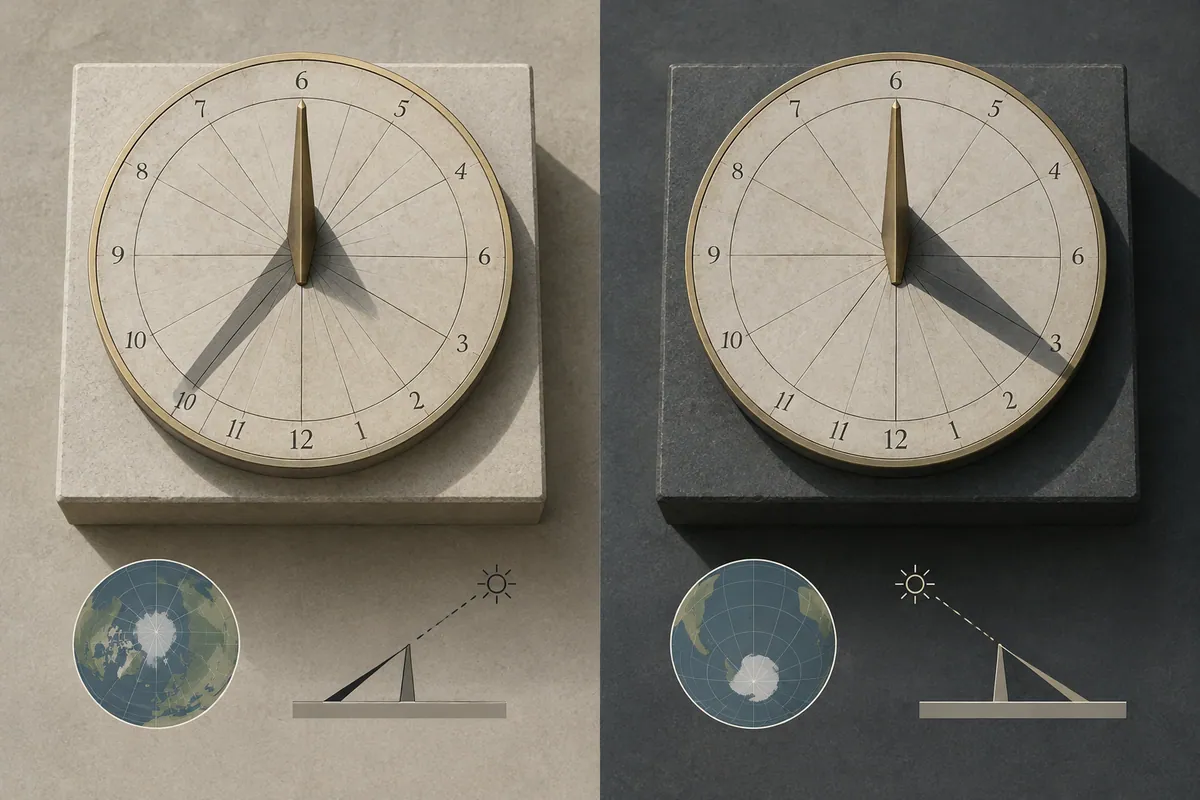
On a horizontal sundial in the Northern Hemisphere, the shadow moves around the dial in the direction now called clockwise. In the morning it points roughly towards the west; around midday it lies towards the north; and in the afternoon it continues towards the east. The hour marks therefore increase in a clockwise direction.
That movement is not because the Sun physically circles the Earth each day. It is the result of Earth’s rotation, which makes the Sun appear to move across the sky from east to west. For people reading a sundial, however, the moving shadow was the visible timekeeper. It supplied a ready-made pattern for dividing a circular face into hours.
Why the Northern Hemisphere mattered
The convention was shaped by where the important early traditions of European clockmaking developed. In the Northern Hemisphere, a correctly aligned horizontal sundial has a shadow that moves clockwise. A sundial built for the Southern Hemisphere behaves differently: depending on its design and orientation, its shadow can move in the opposite direction.
This means clockwise is not a universal property of sunlight or time. It is a local consequence of how a sundial is positioned relative to the Sun and Earth. A clock made in another region, with a different established tradition of sundials, could theoretically have adopted the reverse direction.
The historical link is therefore best described as a strong and plausible explanation rather than a single documented moment when somebody formally decided that all clocks must turn clockwise. Surviving evidence shows that sundials and early clocks belonged to the same long history of timekeeping, but it does not identify one universally accepted inventor of the convention.
From sundial markings to clock faces
Early timekeeping was varied. Ancient communities used sundials, water clocks and other devices to measure or display intervals. Sundials were especially useful because they could show apparent solar time directly from the position of the Sun. Their circular layouts and moving shadows established visual habits that later timekeepers could reuse.
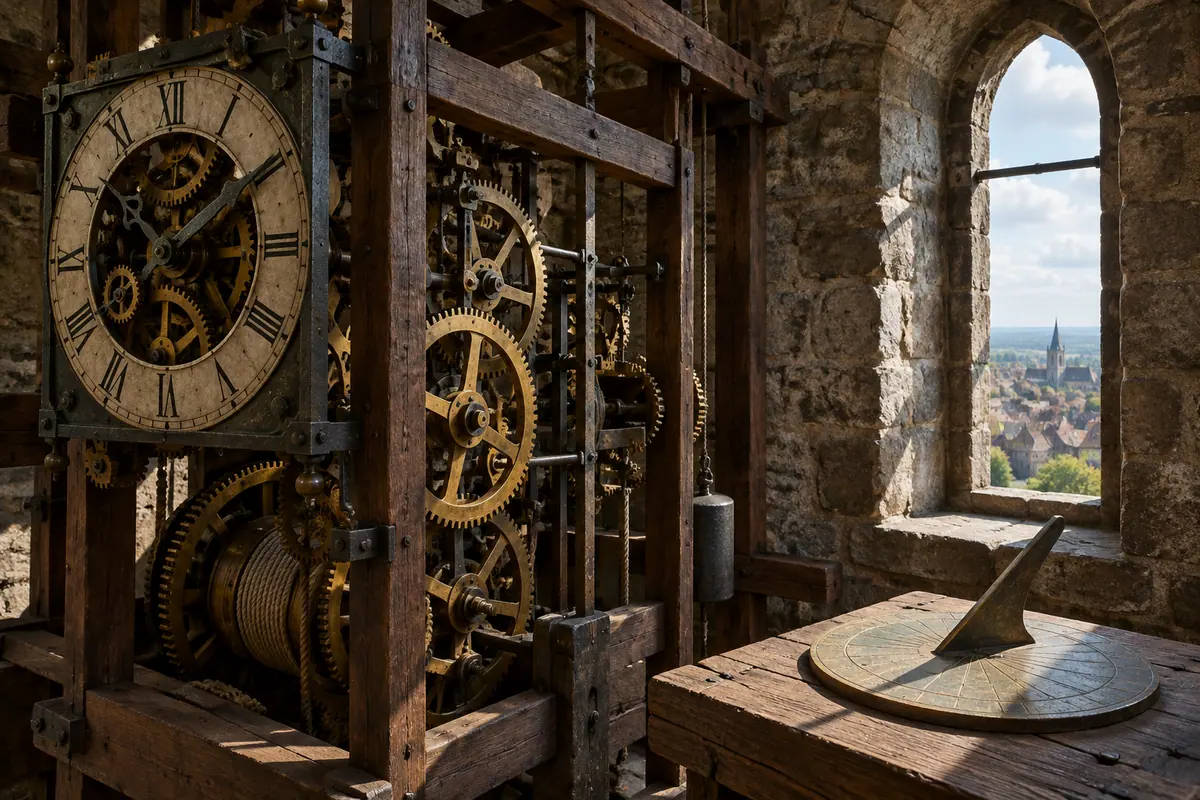
Mechanical clocks emerged in medieval Europe as complex machines driven by weights and controlled by escapements. Early examples were often installed in towers and were designed to strike bells or display the hour. They were not necessarily accurate by modern standards, and clockmakers commonly checked or corrected them against solar observations and sundials.
As mechanical clocks acquired visible dials and moving hands, the established sundial arrangement provided an obvious model. A fixed circular face with the hours arranged in the familiar order allowed a hand to trace the same apparent path as a sundial shadow. The clock did not need to imitate the physical cause of the shadow; it only needed to preserve the direction people already associated with the passage of time.
This is why the numbers on a traditional clock face run from 12 at the top to 1, 2 and 3 on the right, then down through 6 and around to 9 on the left. The arrangement is a visual echo of the Northern Hemisphere sundial.
It was not mechanically necessary
There is no fundamental mechanical law that requires a clock hand to move clockwise. Gears can be arranged to rotate in either direction, and a clock with numbers reversed would still measure equal intervals if its mechanism were built consistently. A counterclockwise clock would not be physically wrong; it would simply be unfamiliar.
Some historical clocks and instruments have used unusual arrangements. Astronomical clocks, experimental designs and specialised scientific instruments have not always followed the standard pattern. Their existence shows that clockwise motion is a convention rather than an unavoidable feature of measuring time.
Conventions become powerful when they are copied. Once clockmakers, builders, mapmakers, instrument designers and the public became accustomed to one direction, changing it would have created confusion without offering much practical benefit. A new direction would require new faces, new instructions and new expectations, while the old direction already worked.
Why did the convention spread worldwide?
Mechanical clockmaking became especially influential in Europe, and European clocks, watches and scientific instruments were traded, copied and exported. As these devices became more widespread, their dial layout travelled with them. The convention was no longer tied only to local sunlight; it became part of an international visual language.
Later technologies reinforced it. Watches, public clocks, timers, speedometers, gauges and rotary controls often use clockwise as the direction of increase or advance. People learn to interpret the movement almost instantly, even when the device has no connection with a sundial.
This spread does not mean every culture had always used the same idea of circular motion. Different societies had their own timekeeping instruments and ways of representing cycles. The modern clock face became dominant because of the historical success of particular mechanical technologies, not because clockwise is inherently more natural to every human being.
What happens south of the equator?
A person in Australia may notice that the traditional explanation feels slightly strange: the Southern Hemisphere is where many modern clocks are now used, yet their hands still move clockwise. That is because the convention travelled with the clock rather than being reinvented from local sundials.
A Southern Hemisphere sundial can be designed to show time accurately, but its shadow pattern is not the same as the pattern that originally influenced European clock faces. If clockmaking had first become standardised in the Southern Hemisphere, anticlockwise hands might have seemed perfectly ordinary. Once a convention becomes global, its place of origin is easy to forget.
So the direction of a clock is a small example of historical momentum. A choice made by the relationship between European sundials and early mechanical clocks became embedded in everyday objects across the world.
What to remember
- Clockwise motion probably comes from the direction of shadows on horizontal sundials in the Northern Hemisphere.
- The choice is historical and conventional, not a requirement of gears, physics or time itself.
- Mechanical clocks developed in Europe and carried their dial layout into global technology.
- A clock could be designed to run anticlockwise and still measure time correctly.
- The Southern Hemisphere inherited the convention even though its sundials can show the opposite shadow direction.
Sources & further reading
Where this story comes from
- The SundialNASA Goddard Space Flight Center
- SundialsRoyal Museums Greenwich
- SundialsMacTutor History of Mathematics, University of St Andrews
- Emergence of TimepiecesSeiko Museum Ginza
- Time and Time Again: A Selection of European Clocks and WatchesThe Metropolitan Museum of Art
- The Sundial Society BulletinThe British Sundial Society
This story was researched, drafted and illustrated with AI, then automatically checked against ANTB's structural and sourcing rules. Use the linked primary and institutional sources to verify important details.
 History · 6 min read
 History · 5 min read
 History · 6 min read