
In this story
A tradition with more than one beginning
There is no single moment when people suddenly decided that the fourth finger should become the wedding-ring finger. Rings were used as signs of betrothal, marriage, status and agreement in several ancient societies, and the customs changed across time and place.
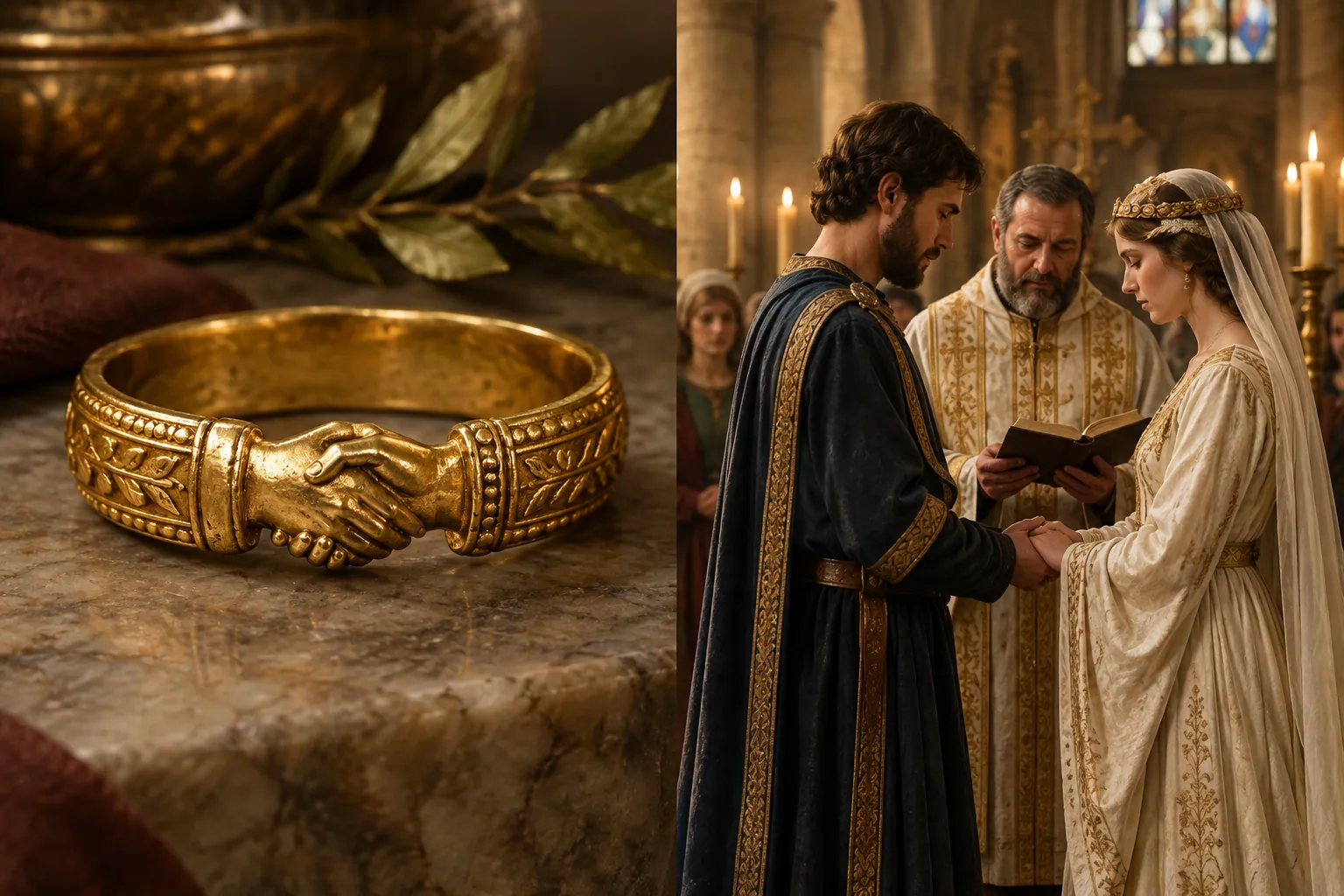
The Roman world is an important part of the story. The Metropolitan Museum of Art notes that the use of rings as betrothal or wedding bands became firmly established in the Roman Empire by the third century CE. Roman marriage rings could show clasped hands, a long-standing symbol of agreement and union. The Church later adopted marriage rings into Christian ceremonial practice, and surviving Christian art from the fourth century shows the tradition continuing in a new religious setting.
That history helps explain why the ring itself became associated with marriage, but it does not prove that Romans everywhere used exactly the modern fourth finger of the left hand. Finger choice was not consistent across all periods, communities or ceremonies.
The ‘vein of love’ story
The most famous explanation is the idea of the vena amoris, Latin for ‘vein of love’. According to this belief, a special vein ran from the fourth finger directly to the heart. A ring placed there would therefore connect the couple’s promise with the seat of love.
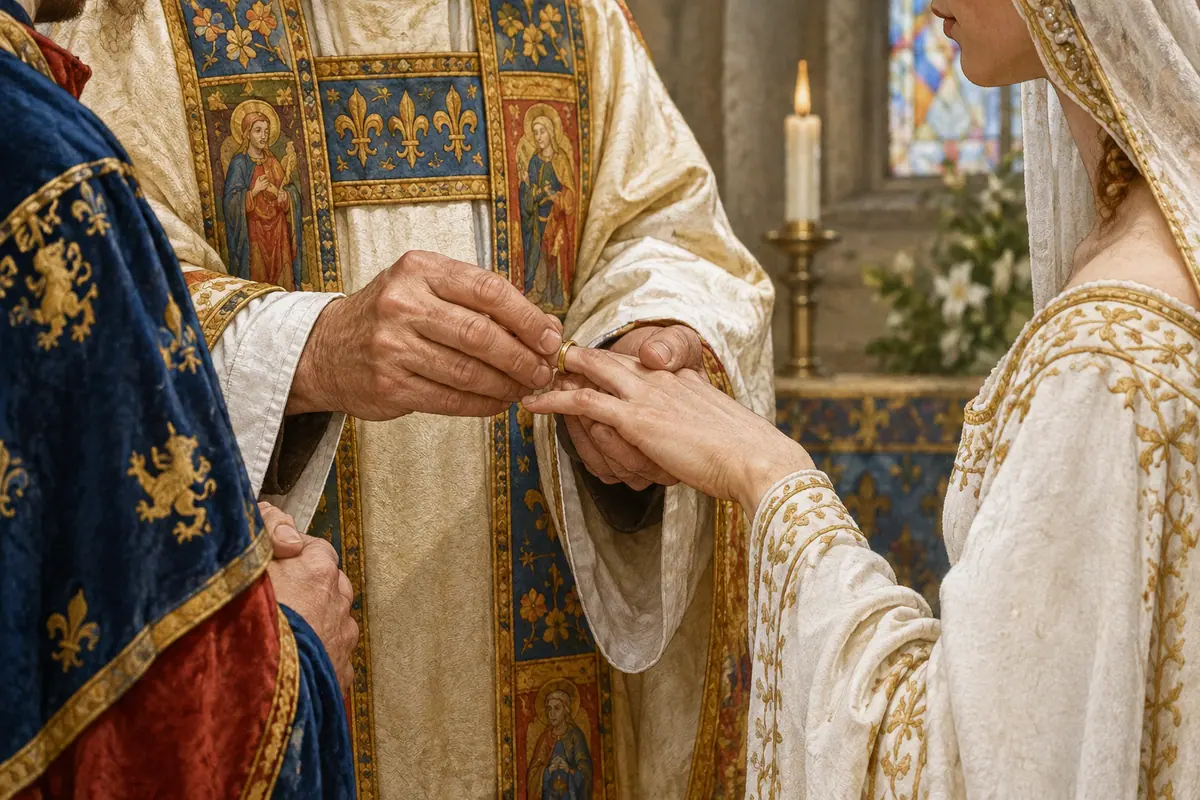
This was a powerful piece of symbolism, but it was not a discovery of human anatomy. Medieval and early modern writers repeated the idea as an explanation for a ceremonial practice. A medieval marriage-rite commentary attributed the choice of the fourth finger to a vein that supposedly reached the heart, while the English Book of Common Prayer directed that the ring be placed on the fourth finger of the woman’s left hand.
The wording matters. These texts describe a belief used to give the ceremony meaning; they are not anatomical studies demonstrating a unique blood vessel. The Latin phrase vena amoris itself appears in much later writing than the earliest wedding-ring customs, so it is safer to treat it as a memorable explanation that became attached to an older ritual rather than as proof of the custom’s original cause.
What the anatomy actually shows
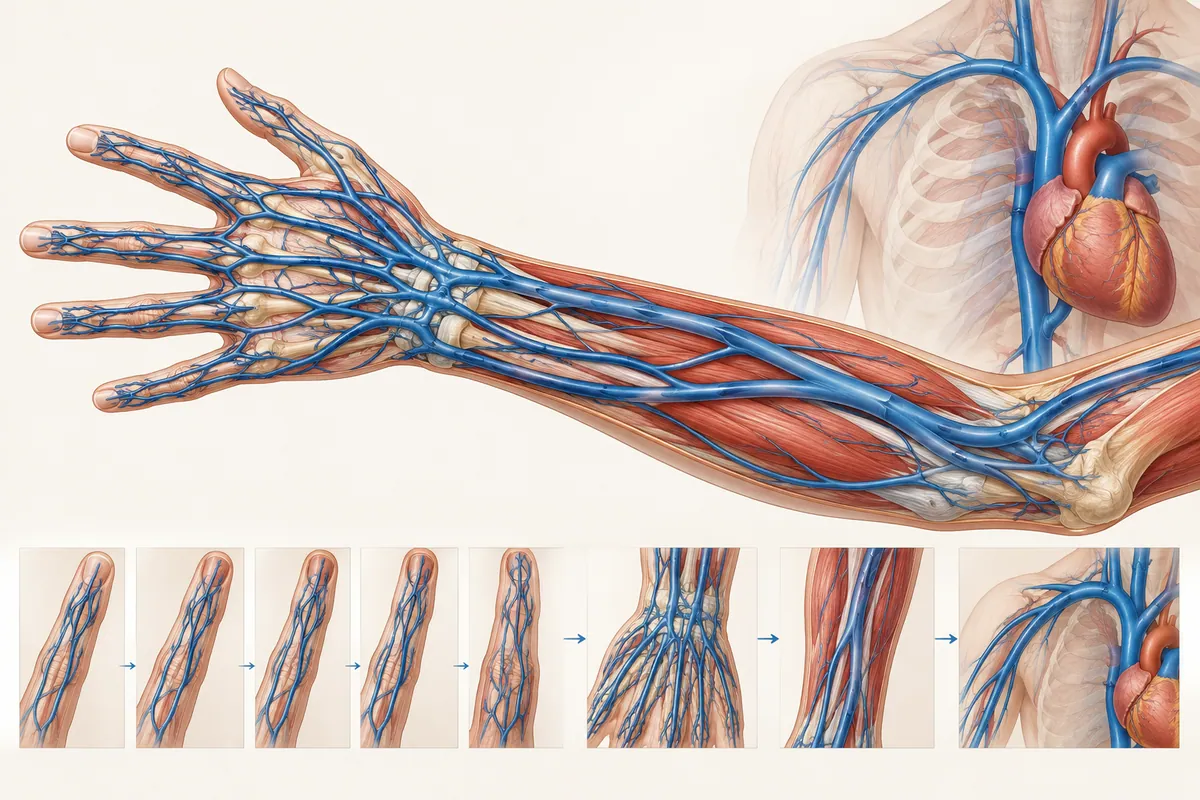
Modern anatomy does not identify a special vein linking the ring finger directly to the heart. Veins from the fingers form interconnected networks in the hand. Blood from the hand drains through larger veins in the forearm and upper arm before reaching the heart.
Anatomical studies of the fingers describe multiple venous channels, arches and connecting vessels rather than one unique route belonging to the fourth finger. The standard venous drainage of the upper limb begins in the digits and hand, then continues through the radial and ulnar veins, the brachial and axillary veins, and finally the veins leading towards the heart.
So the romantic explanation is biologically inaccurate, but that does not make it culturally unimportant. Many traditions use imagined links between the body and emotion. In this case, the supposed vein gave a physical image to an abstract promise: the hands were joined, and the hearts were imagined to be joined with them.
Why the left hand in many Western countries?
The left-hand custom developed alongside Western Christian ceremony, but it was never universal. The medieval evidence is mixed. The British Museum records that, in some late-medieval marriage ceremonies, the ring was blessed and placed on the bride’s right hand. Other rites and later English practice specified the fourth finger of the left hand.
The English Book of Common Prayer helped standardise the left fourth finger in a particularly influential Protestant setting. Once a ceremony, prayer book or legal custom gives a precise instruction, repetition can turn it into an apparently timeless rule. Families copy what they have seen, jewellers design around it, and people learn to recognise the finger as a visible sign of marriage.
There may also have been practical reasons for preferring the left hand in some places. For many people the right hand is more heavily used, so a ring on the non-dominant hand may be less exposed to knocks and wear. That may have reinforced the custom, but it is difficult to separate practical considerations from later explanations because the historical records usually describe ceremony and symbolism rather than everyday convenience.
The finger is not universal
Even within Europe, wedding-ring customs have varied. The British Museum’s collections show marriage rings associated with different hands and ceremonies, while the Metropolitan Museum documents Jewish marriage rings whose symbolism and ritual use developed along their own path. Some Jewish ceremonial rings, for example, were large and elaborate objects intended for use during the wedding rather than for ordinary daily wear.
In a number of countries and religious communities, wedding rings are traditionally worn on the right-hand ring finger. The choice can depend on local law, church practice, religious interpretation or inherited custom. A person may also move a ring from one hand to the other after a spouse dies, during an engagement or when a local tradition differs from the one used at the wedding ceremony.
This variety is a useful warning against treating the left fourth finger as a universal human instinct. It is better understood as one widely exported Western convention among several legitimate ways of giving a ring its meaning.
Why the custom lasted
Wedding rings endure because they do several jobs at once. They are jewellery, personal keepsakes, public signals and ritual objects. A ring can mark a promise during a ceremony, then continue to communicate marital status in everyday life.
The circular shape also makes the object well suited to symbolism. It has no obvious beginning or end, so it can represent continuity. The material may express wealth or family history, while the act of placing the ring on a particular finger turns an ordinary piece of jewellery into a recognised social sign.
The fourth finger survived not because it contains a hidden path to the heart, but because people repeatedly attached meaning to it. Religious ceremonies gave the placement authority; stories about the vena amoris made it emotionally memorable; and social habit made it instantly recognisable. Once millions of people used the same finger, the custom became self-reinforcing.
What to remember
- The fourth finger became associated with wedding rings through a gradual mixture of Roman, Christian and later European traditions.
- The supposed vena amoris, or ‘vein of love’, is a symbolic belief rather than an accurate description of human anatomy.
- Medieval marriage rites and the English Book of Common Prayer helped establish the fourth finger of the left hand in influential Western traditions.
- Wedding rings are worn on different fingers and hands in different cultures, so the left ring finger is not universal.
- The custom survived because ritual, symbolism and social recognition reinforced one another over centuries.
Sources & further reading
Where this story comes from
- Gold Finger RingThe Metropolitan Museum of Art
- Recent Acquisitions: A Selection, 2016–2018The Metropolitan Museum of Art
- Ring: Fede Ring CommentaryThe British Museum
- Courtship and Betrothal in the Italian RenaissanceThe Metropolitan Museum of Art
- Marriage in the Medieval AgesNova et Vetera
- Anatomy, Shoulder and Upper Limb, VeinsNational Center for Biotechnology Information
- The Palmar Digital Venous AnatomyPubMed
This story was researched, drafted and illustrated with AI, then automatically checked against ANTB's structural and sourcing rules. Use the linked primary and institutional sources to verify important details.
 Culture · 6 min read
 Culture · 6 min read
 Culture · 6 min read