
In this story
A greeting with no single inventor
There is no confirmed moment when someone first invented the handshake. Human societies have long used hands to communicate things that words cannot easily express: welcome, agreement, friendship, submission, farewell or reconciliation. Because clasped hands appear in several ancient cultures and in different situations, historians cannot point to one place or person as the origin of the custom.
One popular explanation is that an outstretched right hand showed that a person was not holding a weapon. It is an appealing idea, but it should be treated as a theory rather than an established fact. There is no firm evidence that handshakes began specifically as a method of checking for hidden weapons, or that the up-and-down movement was designed to shake a dagger from someone’s sleeve. The safer conclusion is that an open, extended hand was a visible sign of approach rather than attack.
What ancient images can tell us
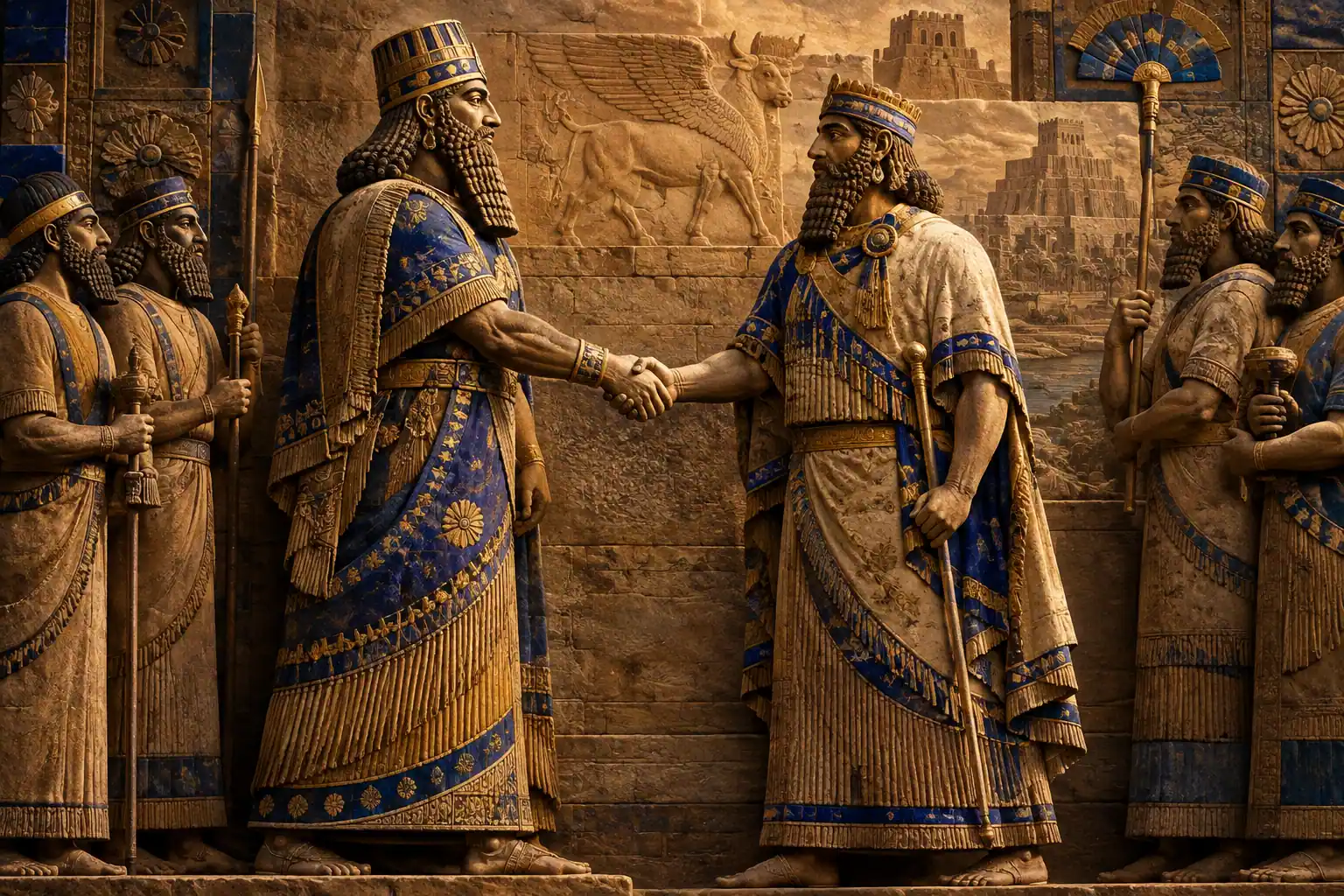
Some of the earliest surviving images of clasped hands come from the ancient Near East. A ninth-century BCE Assyrian relief shows King Shalmaneser III clasping hands with the Babylonian ruler Marduk-zakir-shumi. Scholars have interpreted the scene as representing an alliance or agreement between rulers, although the precise meaning of any ancient gesture can be difficult to recover from an image alone.
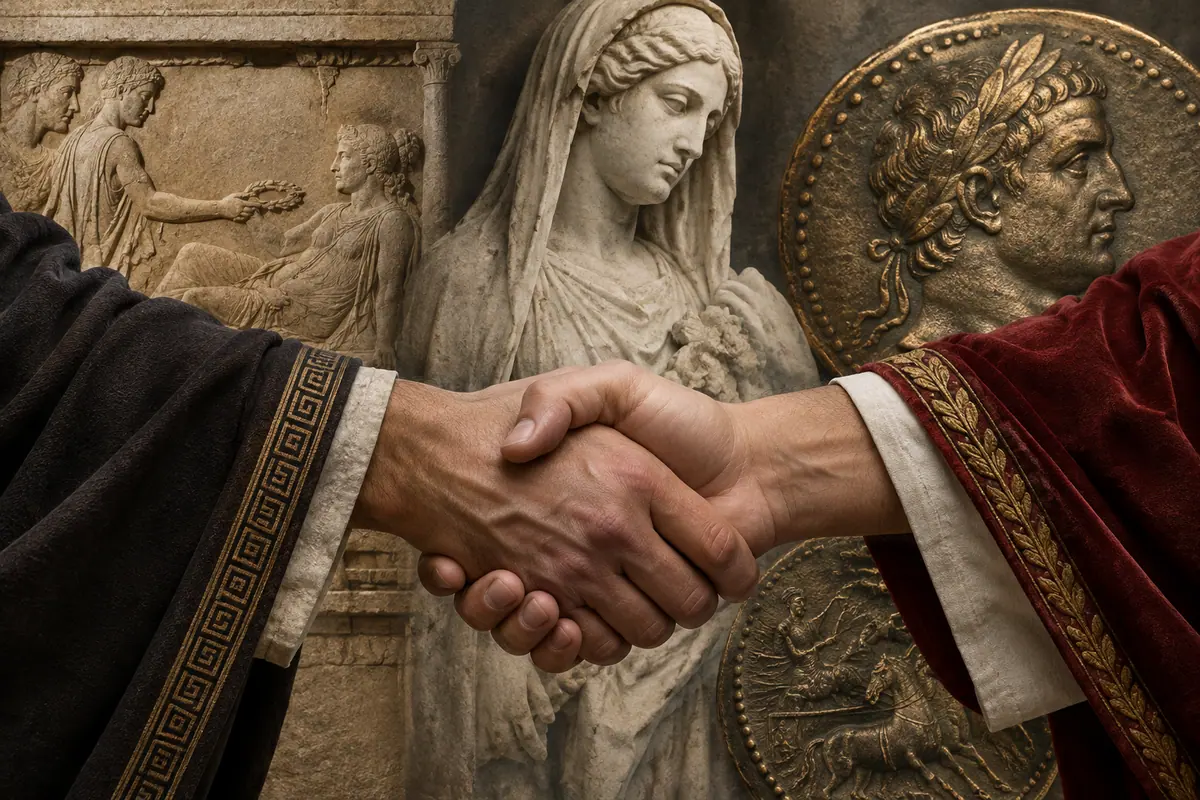
Other ancient evidence shows that a handclasp could carry several meanings. Greek funerary art sometimes depicts the dead person shaking hands with a relative, a visual symbol that may suggest farewell, family connection or an enduring bond. In the Roman world, clasped hands appeared as a sign of loyalty and friendship, including on coins. These examples do not prove that ancient people used handshakes as ordinary greetings in the modern sense. They show instead that joining hands was already a powerful symbolic act.
The distinction matters. A gesture can exist for centuries without becoming an everyday social habit. Ancient rulers might clasp hands to mark an alliance, while ordinary people used other forms of greeting, such as bows, embraces, kisses or spoken formulas. The handshake’s long history is therefore not the same thing as a continuous history of shaking hands whenever people met.
From agreement to everyday greeting
The handshake appears to have become more common as an everyday greeting in Europe during the early modern period. One important influence was the Religious Society of Friends, commonly known as the Quakers, who emerged in England in the 1650s. Friends emphasised the spiritual equality of people and rejected customs that displayed deference to social superiors, including elaborate hat-taking and forms of address that marked rank.
A simple handclasp suited that outlook. Unlike bowing deeply or kissing someone’s hand, it could be performed by two people standing as apparent equals. This does not mean the Quakers invented the handshake. Rather, their religious and social principles helped give the gesture a particular meaning: plain, direct and comparatively egalitarian.
The custom then spread through changing patterns of work, trade and public life. By the nineteenth century, etiquette manuals in Britain and elsewhere were discussing how a respectable handshake should be performed. Advice commonly concerned moderation: the grip should be neither limp nor painfully strong, and the movement should be controlled rather than theatrical. The fact that etiquette writers were prescribing the correct handshake suggests that it had become an established part of formal social behaviour.

Why the right hand?
In many European and North American settings, the right hand became the conventional hand for shaking. The reason is partly practical and partly cultural. Many societies historically associated the right side with honour, correctness or formal action, while the left hand was assigned different practical or symbolic roles. The right hand also became the hand used for pledges, greetings and agreements in many Western traditions.
However, the right-handed handshake is not a universal human rule. Greeting customs vary widely between cultures, religions and situations. Some communities prefer bows, namaste-style gestures, placing a hand over the heart, kisses, embraces or simply a verbal greeting. Even where handshakes are common, people may adjust the gesture according to age, status, gender, religious practice, familiarity and local etiquette.
That variation is a reminder that no greeting is just a mechanical movement. A handshake works because people recognise its social meaning. Without that shared understanding, clasping hands could be confusing, intrusive or inappropriate.
What a handshake communicates
A handshake is a small ritual of mutual participation. Both people normally offer a hand, make contact and release it within a short time. That structure can communicate several ideas at once: I acknowledge you; I am willing to approach you; we are meeting on agreed social terms; and this interaction has begun.
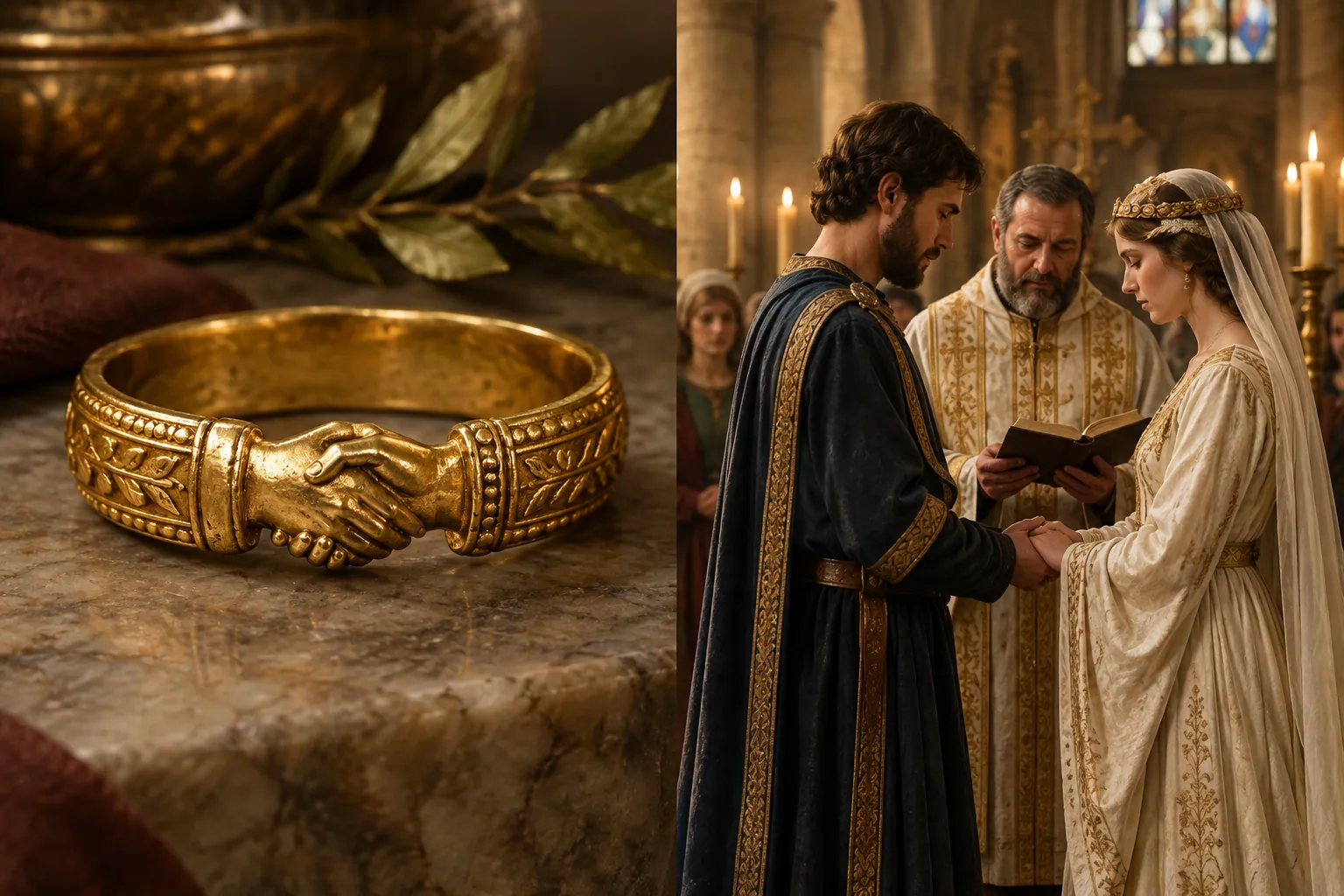
The gesture can also mark a promise or settlement. In many societies, people have used joined hands to confirm an agreement, seal a bargain or show reconciliation after a dispute. The symbolism is easy to understand: two separate people create a temporary physical connection, then part with an understanding that something between them has changed.
At the same time, handshakes have not always represented equality. A handshake can be offered by a superior to a subordinate, used ceremonially by leaders or performed in a way that asserts confidence and control. Grip strength, duration, eye contact and who extends a hand first can all influence how the gesture is interpreted. The handshake is therefore an egalitarian ideal, not an automatic guarantee of equal treatment.
Why did handshakes become so familiar?
The modern handshake benefited from being quick, portable and easy to recognise. It requires no object, special clothing or shared language beyond the expectation that both people understand the gesture. It can be used in a crowded room, at a business meeting, during a ceremony or when two strangers are introduced.
Its spread was also connected with the growth of formal institutions and commercial life. Schools, workplaces, clubs, courts, political organisations and businesses all needed brief rituals for introductions and agreements. The handshake fitted these settings particularly well because it was formal without being elaborate.
Still, its popularity should not be mistaken for universality. In different periods and places, handshakes have competed with other greetings or been avoided for religious, hygienic, political or cultural reasons. A greeting becomes normal not because it is biologically inevitable, but because a community repeatedly teaches people what it means.
What to remember
- The handshake has no known single origin, and the popular weapon-checking explanation remains unproven.
- Ancient images show clasped hands being used for alliances, loyalty, farewells and other symbolic purposes.
- The handshake became an everyday greeting in Europe and North America much later than the earliest ancient depictions.
- Quaker ideas about equality helped give the handclasp a socially egalitarian meaning in the seventeenth century.
- Greeting customs vary widely, so a handshake is appropriate only when the surrounding culture and situation support it.
Sources & further reading
Where this story comes from
- The History of the HandshakeHISTORY
- The Black Obelisk of Shalmaneser IIIThe Nimrud Project, University of Pennsylvania Museum
- The Black Obelisk of Shalmaneser III — Rediscovery and modern receptionThe Nimrud Project, University of Pennsylvania Museum
- How do Quakers practise equality and equity?Quaker Spirituality
- Equality TestimonyBirmingham Quakers
- SalutationsEncyclopedia.com
- HandsEncyclopedia.com
This story was researched, drafted and illustrated with AI, then automatically checked against ANTB's structural and sourcing rules. Use the linked primary and institutional sources to verify important details.
 Culture · 6 min read
 Culture · 6 min read
 Culture · 6 min read